People that wish to travel to Australia by plane have to apply for a visa before going. This is due to the fact that, when you apply for an Airline Transport Visa (and not an Australian Passport), you will need to make certain that the airline has the authority to issue your flight ticket. The Australian embassy is a government agency that allows people to apply for visas in advance.
The Australia tourist visa is designed for people who are not eligible for the eVisitor or Electronic Travel Authority visa. This visa allows you to visit Australia, either for tourism or business purposes. You can apply for an Australia visa in India by visiting the nearest VFSGlobal or we can help you get your Australia tourist visa by taking care of your entire visa process on your behalf.
It is possible to get an Australia tourist visa with a qualified agent. It cannot be applied online by yourself. Australia tourist visa will be a paper visa, which means the visa will be a pdf of which you need a printout and carry when you visit Australia.
Our assistance begins right from the time you submit your request. Our internal agent will look at each application and create the list of documents you need to submit to successfully get a visa. Then our customer support will call you and give you a brief of all the documents that need to be sent. Should you accept our proposal, A Australia visa expert will be assigned to visit your place at your convenient time of appointment
The expert will handle all the processes and solve all your queries related to Australia visa. Your document is then submitted to the verification team who will scrutinize each document to ensure that it meets all Australia tourist visa.
Once we receive an ok from our team, we will take it to the Australian embassy with your presence for further processing.
Prince Edward Island invited Express Entry, Labour Impact, and Business Impact immigration applicants this month.
Canada’s island territory invited 194 immigration applicants to make one stride nearer to permanent residence.
The Prince Edward Island Provincial Nominee Program (PEI PNP) held two invitation rounds so far in July.
The 1st draw was held on July 10, when the territory invited eight Labor Impact and Express Entry applicants to give an application for a provincial nomination. The PEI PNP didn’t tell of what number of applicants was invited from every immigration classification.
The draw on July 16 was substantially bigger. There were 157 applicants invited from the Labour Impact and the Express Entry class. The PEI PNP additionally invited 29 Business Impact applicants that day.
Generally the PEI PNP follows a pre-decided timetable for holding invitations. This year, the coronavirus pandemic has messed up the area’s plans. PEI has held two draws on time since March, on June 18 and July 16.
The next draw is planned for August 20.
PEI Express Entry Category
The PEI PNP Express Entry Class lined up with the Canadian government Express Entry system.
Express Entry manages with the applications for three economic-class immigration types: Federal Skilled Worker Program, Federal Skilled Trades Program, and Canadian Experience Class.
Qualified applicants are given a Comprehensive Ranking System (CRS) score for their age, work experience education, and language expertise in English and French.
Express Entry applicants who get a provincial nomination are given an extra 600 points toward their CRS score, and are adequately guaranteed an Invitation to Apply (ITA) for permanent residence in a resulting Express Entry draw.
So as to be considered for a provincial nomination from PEI, Express Entry applicants required to make an Expression of Interest (EOI) profile with the PEI PNP.
EOI profiles are given point’s base on the territory’s special point’s framework. The most elevated scoring applicants are then invited to give an application by monthly draws.
The PEI PNP didn’t give a breakdown of what number of Express Entry and Labor Impact applicants were invited, nor the least EOI score required for every type.
Labour Impact Category
Applicants in the Labor Impact Type were invited in the two rounds this month.
This immigration type is for remote nationals who have a legitimate employment offer in PEI, and have support from their manager. It is separated into three streams: Skilled Worker, Critical Worker, and International Graduate.
Applicants include in this classification have to present an EOI profile in order to be considered for a provincial nomination through the Labor Impact type.
Business Impact Category
The PEI PNP provided invitations to 29 applicants with an EOI profile in the Business Impact: Work Permit Stream on July 16.
Those invited needed to have at least EOI score of 117, the similar as the past Business Impact draw on June 23.
The Work Permit Stream is for business people who wish to possess and work a business in PEI.
FSWP and FSTP candidates eligible to receive invitations to apply for permanent residence in the first all-program draw since March 4.Canada has resumed all-program Express Entry draws and is now issuing invitations to apply to Federal Skilled Worker Program (FSWP) candidates.
Canada’s first all-program Express Entry draw since March 4 has issued 3,900 invitations to apply (ITAs) for permanent residence. Candidates needed a Comprehensive Ranking System (CRS) score of at least 478 to be invited in the July 8 invitation round.
Since the coronavirus was labeled a pandemic and Canada introduced travel restriction to prevent its spread, Express Entry draws have been limited to Provincial Nominee Program (PNP) and Canadian Experience Class (CEC) candidates. This left FSWP and Federal Skilled Worker Program (FSTP) candidates in limbo. Most CEC candidates are already in Canada and therefore are not affected by Canada’s current travel restrictions.
PNP candidates continue to be invited as well to allow provinces to meet their labor market needs. It is important to note however that even when Canada was excluding FSWP and FSTP candidates, some of the CEC and PNP candidates being invited in previous draws were also outside of Canada.
Canada invited 529 Express Entry candidates to apply for permanent residence on May 13, 2020. Canada has now invited 34,829 immigration candidates so far this year.
This PNP-specific draw appears to follow a pattern from Immigration Refugees and Citizenship Canada (IRCC) where Express Entry draws will alternate between targeting candidates with provincial nominations, and those from the Canadian Experience Class (CEC). The previous Express Entry draw selected only CEC candidates and had a CRS cut off of 452, which is the lowest of the year so far.
IRCC has been holding Express Entry rounds this way since Canada closed its borders in an effort to stop the spread of coronavirus on March 18. For a while the future of Express Entry draws was uncertain, as these times have often been described in general. However, if we look back on the years it seems despite travel restrictions, and this new way of conducting Express Entry draws, there have still been more ITAs issued in 2020 than the same time in 2019 and 2018.
The people who are eligible for one of these programs submit their profile into the Express Entry pool, where they are given a CRS score based on their human capital factors such as age, work experience, education, and language ability in English or French. The highest-ranked candidates are then invited to apply for permanent residence through regular Express Entry draws.
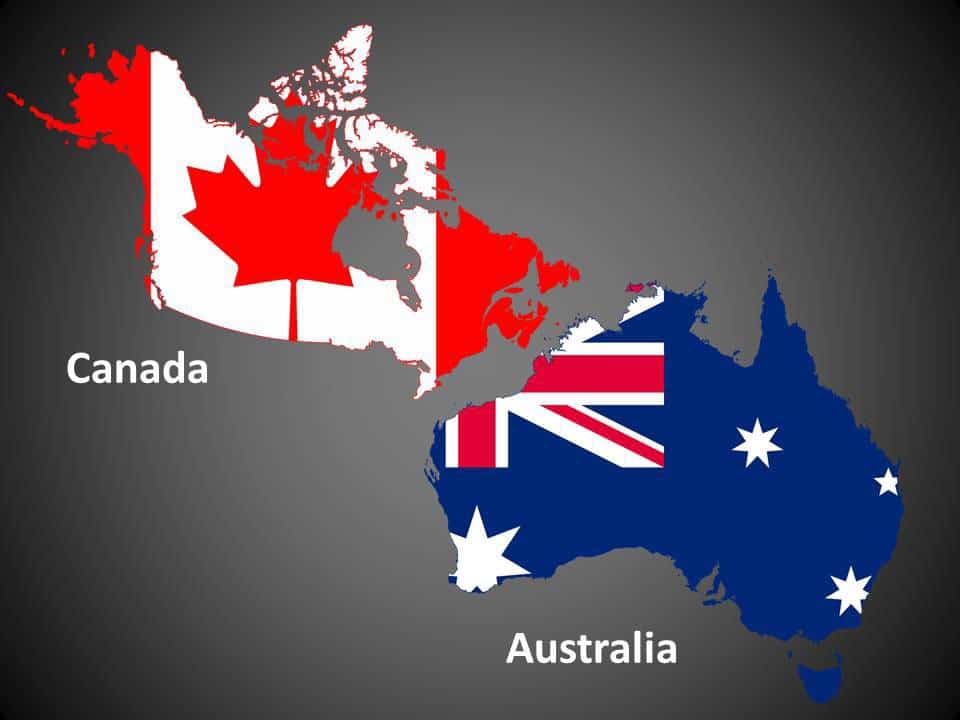
Canada and Australia have pursued completely various immigration plans in these years—a trend which has continued during the corona virus crisis.
Immigration is important to the economic health of both Canada and Australia. In these years, the two countries have become increasingly reliant on new permanent residents and temporary visa holders such as international students and foreign workers to support their population, labour force, and economic growth.
International students are a useful proxy to assist us understands the economic advantages of immigration in both countries. The international students contribute some $22 billion yearly to the Canadian economy, helping 170,000 employments in the process. They contribute $39 billion to Australia’s economy annually and support 240,000 employments.
OF Canada’s 38 million people some 22 percent people are immigrants while of Australia’s 25.5 million people some of 30 percent are immigrants.
This tells us that the 8 million immigrants in every country have an even larger—and more positive—impact on the economy and employment creation.
However, Canada and Australia have pursued fully different immigration plans in these years—a trend which has continued during the corona virus crisis.
Immigration plans going in opposite directions
Canada has been permanently growing its immigration levels since the late 1980s, and in these years, has been growing them more aggressive to support its economy. Australia also began to extend its levels in the late 1990s but it’s shifted course over the previous some years.
Only some days before it had been hit hard by the corona virus crisis, Canada declared it might be targeting the arrival of 340,000 permanent residents in 2020 (which on a per capita basis, is 0.9 per cent of its population) and even higher levels in 2021 and 2022. Canada was previously averaging around 260,000 permanent resident arrivals each year until 2016 when it decided it might be aiming for a minimum of 300,000 annual arrivals.
The Canada is targeting 58 per cent of its immigrants to arrive under the economic class, 27 per cent under the family class, and 15 per cent for refugee and other humanitarian grounds.
During this, Australia declared previous year that it had been decreasing its annual permanent resident target by 30,000 to 160,000 immigrants annually until 2023 (0.6 percent of its population). Before the declared cut, Australia has frozen its target at around 190,000 immigrants for eight straight years.
According to the Australia’s recent plan, 70 per cent of immigrants will come under the economic class and 30 per cent under the family class.
Canada inviting even more immigration applicants during COVID-19 pandemic
The corona virus pandemic has understandably affected both countries’ immigration systems; however Canada is still trying to come as near as possible to obtaining the economic class targets outlined in its immigration levels plan.
In April, Canada provided 11,700 invitations to give an application for fixed residence under its federal Express Entry application management system, compared with 7,800 the last month, and 8,000 in February. Besides, Canada’s provinces still provide permanent residency pathways for immigration applicants during this era.
On the opposite hand, the pandemic has resulted in a important decline in Australia’s economic class invitations.
Previous month, Australia issued 100 invitations under its Skill Select expression of interest system, compared with 2,050 in March, and 1,500 in February.
Why both countries need immigrants
Both Canada and Australia welcome immigrants thanks to their aging populations and fewer birth rates.
In Canada the median age is 41 while in Australia its age is 38.
In Canada’s birth rate is 1.5 while in Australia it is 1.7.In both situation, the birth rate is below what’s needed to easily replace the population (2.1 babies per woman).
In 2018-19, Canada’s population grew by 1.4 per cent (531,000 people), with 82 per cent of the population growth because of permanent and temporary resident comes, and 18 per cent from natural increase (births minus deaths).
In 2018-19, Australia’s population grew by 1.5 percent (371,000 people), with 62.5 percent of the population growth coming by permanent and short-term residents, and from natural increase 37.5 percent.
Immigration has proven important to both countries abilities to help labour force growth, which is among the two ways to grow the economy.
Besides, immigrants assist to alleviate the fiscal pressures both countries face because of their aging populations since the economic activity created by immigrants assists to support the govt revenues that are necessary to fund important social services such as health care, which is just becoming more costly to deliver because of rapid population aging.
How will Canada and Australia respond post-corona virus?
Some political leaders in Australia are already demanding for even more cuts to the country’s immigration levels because of the COVID-19 crisis. As an example , Senator Kristina Keneally recently declare in the Sydney Morning Herald that maintaining the equal levels of immigration will be hurt Australian workers.
There has been less political discussion so far in Canada on the country’s immigration policies post-pandemic; however Canada’s immigration minister recently advised that the federal govt remains committed to welcoming immigrants to assist Canada’s economic recovery.
Given how fluid the corona virus crisis is, nobody can predict the longer term of Canada and Australia’s immigration policies. Although, Canada’s decision to invite more Express Entry immigration applicants previous month is telling of its desire to continue high levels of immigration to help its economy.
Besides, there are four factors that have enabled Canada to maintain high levels of immigration, even following difficult economic eras including after the 2008-09 global financial crisis.
The four factors of Canada’s history, geography, policies, and politics can see Canada stick near to its 2020-2022 Immigration Levels Plan once the pandemic is behind us.
Why the worldwide economic slowdown is unlikely to vary Canada’s immigration plans post-corona virus.
The corona virus pandemic is having a devastating effect on economies overall the world.
The IMF projects the worldwide economy will contract by 3 per cent in 2020, in what it calls the worst economic downturn since the serious Depression.
Just days before it announced travel restrictions to assist contain the spread of COVID-19, Canada said it might welcome over 1 million immigrants between 2020-2022, mainly to assist grow its economy.
Of course, little did Canadian officialdom know at the time of the declared that the worldwide economy would be heading towards such a serious contraction.
Should Canada welcome further immigrants?
The present state of affairs may lead one to legitimately question whether Canada should continue with its immigration plan, or scale it back.
There is no dubiety that COVID-19 would require Canada to regulate its immigration plan.
Nevertheless, it would not be sound economic policy to significantly lower Canada’s immigration levels beyond the corona virus crisis.
The reason for this is often that Canada require further immigrants it ever has in its modern history to encourage economic process.
Why Canada requires more immigrants?
Canada’s desire to welcome over 300,000 immigrants per annum is supposed to assist alleviate its demographic challenges.
Canada one of the world’s lowest birth rates and one of the world’s oldest populations. As more Canadians retire, it’ll struggle to exchange them within the labour market since the country isn’t having enough children. This is where often where immigration comes in.
Immigration has been the major driver of Canada’s population increase since the 1990s, and would be the just driver of it by the untimely 2030s.
Population growth is vital because it fuels labour force growth. The two ways to extend an economy is by including more workers and using these workers more productive.
Today, immigration tends to account for all of Canada’s labour force growth, or the overwhelming majority of it, during a given year. This suggests that Canada would constrain its economic process potential if it welcomed fewer immigrants.
Canada will see a full economic recovery?
The consensus between economists is that the Canadian and worldwide economy must be rebound fairly rapidly once social distancing measures are eased.
This suggests that further Canadians would be back to work, and there’ll even be further job opportunities for immigrants.
The Canada’s economy pre-coronavirus is extremely telling of what we may expect once the economy is back to normal.
Leading up to the coronavirus pandemic, Canada’s joblessness rate was at lows and its economy enjoyed a decade of growth following the 2008 global financial crisis. Remember that Canada keep up high levels of immigration even following that crisis, which in hindsight, was the right economic decision to form.
One significant cause for the low joblessness rate pre-coronavirus is many of Canada’s over 9 million baby boomers were retiring, which reasoned a reduce of workers because the economy was expanding. This gained Canadian-born workers and immigrants alike.
Similarly, Canadian-born workers and immigrants are poised to gain from the post-coronavirus economic rebound. Within the coming years, it’s realistic to expect Canada to affect worker shortages again, and even more so than before COVID-19 as all of Canada’s 9 million baby boomers reach the age of retirement within subsequent decade.
Immigration policy always has lengthy economic implications and that we must not lose sight of that even within the wake of the coronavirus crisis.
Immigrants will help to build further jobs post-coronavirus
Canada’s economy is facing hard times, but immigration will play a important role in supporting Canada’s economic recuperation since immigrants will help to fill newly-generated jobs and also support job making in other ways.
Statistics Canada research shows that immigrants have a big propensity to begin businesses. In one among its recent studies, Statistics Canada found that immigrant entrepreneurs generated 25 per cent of latest private sector jobs between 2003 and 2013, albeit they accounted for 17 per cent of companies studied. In other words, immigrant entrepreneurs punched above their weight when it came to job creation.
Consequently, immigrant entrepreneur’s post-coronavirus would generate businesses which would generate new jobs for fellow Canadians.
At last, immigrants bring significant savings with them which helps to fuel the economic activity that’s critical to fueling job creation in Canada.
Consider the useful proxy of international students. Consistent with the federal govt, the over 600,000 international students in Canada contribute over $22 billion in economic activity annually which supports nearly 200,000 Canadian jobs.
Canada has over 8 million immigrants, who make a good bigger contribution to economic growth and generating job than international students.
The express entry candidates, skilled workers both in Manitoba and abroad, as well as international graduate’s students invited to apply for provincial nomination.
Manitoba held its fresh provincial nominee program on 12 March, which invited a total 222 immigration candidates toward fixed place.
The Manitoba Provincial Nominee Program (MPNP) held its 85th Expression of Interest (EOI), which is invited three immigration candidates.
Skilled Workers in Manitoba: 191 candidates invited
Skilled workers abroad: 13 candidates invited
International Education Stream: 18 candidates invited
In this program there were also 17 express entry candidates who received invitations, known as Letters of Advice to Apply (LAAs) in this draw.
LAAs for Express Entry candidates
Federal Skilled Worker Program,
Federal Skilled Trades Program,
And Canadian Experience Class.
These are the main three express entry Canada economic-class immigration programs; Express entry manages the applications for these programs.
The candidates who are qualified for express entry are given a Comprehensive Ranking System (CRS) score based on factors such as age, work experience, education, and official language proficiency.
The highest scoring candidates are invited to apply for fixed place by the express entry draw, this process generally happen in each two weeks.
The express entry candidates get additional 600 points toward their overall CRS score with a provincial nomination. This bonus gives proof that they will receive an Invitation to Apply (ITA) in a subsequent Express Entry draw.
The express entry candidates must offer separate EOI profile to the MPNP and have qualified work experience.
Manitoba’s Expression of Interest system
Manitoba skilled workers and broad skilled workers categories, the candidate need to register an EOI with the MPNP, In order to be invited to apply for a provincial nomination.
EOI is a online profile that is ranked out of a score of 1,000. Points are awarded for a candidate’s education, work experience, connections to Manitoba and proficiency in English or French, among other factors.
The invited skilled workers candidates in Manitoba stream had a score 496, in the fresh draw.
The lowest-ranked candidate invited from the Skilled Workers Overseas Stream had a score of 672.Canada Skill Immigration Details
Skilled Workers Overseas and Skilled Workers in Manitoba
The skilled workers abroad category permission the MPNP to choose and nominate skilled foreign workers who can provide help Manitoba’s labour market.
The candidates must have an established connection to Manitoba like close family or friends, old education or work experience in the province, or an invitation through one of the MPNP’s Strategic Recruitment Initiatives, among other requirements.
They do not important to be in Manitoba at the time of application in order to be qualified.
The 13 candidate was invited directly by the MPNP under a Strategic Recruitment Initiative. Some candidates invited through the Skilled Workers abroad Stream.
Some candidates invited through the Skilled Workers in Manitoba category. The 191 candidates should have a full-time fixed job offer from a Manitoba employer, among other criteria.
International Education Stream
Manitoba international student graduates with in-demand skills can be invited under the International Education Stream.
A new proof of funds required to determine eligibility for Federal Skilled Worker Program & Federal Skilled Trades Program candidates in 2020.
The amount of funds needed depends on the size of the family included in the application. According to Immigration, Refugees, and Citizenship Canada (IRCC), the following family members can be included on an application for Canadian permanent residence:
1. the principal applicant;
2. their spouse or partner;
3. their dependent children; and
4. their spouse’s dependent children
Spouses and dependent children must be included in the application even if they are already permanent residents or Canadian citizens, or if they are not coming to Canada with the applicant.
For more information visit Canada Government Website: CIC News
Get advice from our expert consultants: Contact us
Word Immigration conventional means is migration from your homeland to any other country where you get more benefits and advantages. Now a day’s every developed and established countries welcome all professionals and experts to grow in their respective fields with whole new environment. Canada is on no.1 along those countries who appreciates , invites and encourages all skilled Immigration to flourish with them. This program is specially designed for skilled Immigration who wants to migrate to Canada.
With this opportunity they can can move to whole new professional dimension .This program gets immigrants to settle in world’s best country and enjoy a whole new different lifestyle. There are several opportunities waiting for you just cross the line to settle down with best economic stable country. The skilled immigrants gets all the basic needs and requirements to enjoy the ease of life
There are three primary options to continue your case
Any applicant who wants to apply for this program needs to meet 67 points in the profile. Applicant able to achieve this point through Education, Age, Immigratoin experience, ielts and adaptability points (partner ielts, Canadian relatives point, and Canadian work experience points.
[wpsm_comparison_table id=”1″ class=””]
[wpsm_comparison_table id=”4″ class=””]
Documents:
All application fee
Attestation of all certificates of applicant and partner by native country Educational Bodies.
You enclosed all documents and transcripts into a sealed envelope.
Ielts Certification
Original birth certificate of applicant, partner, and kids.
Kids educational documents if required.
CNIC in translated in English of applicant and partner.
UC and Foreign office attested Marriage certificate translated in English.
The principal applicant and all family members who are more than 18 years required Police Character Certificate.
Required passport size picture of the principal applicant and all family.
Require Bank statement for showing financial assistance in Canada for the principal applicant and all other family members.
Other Documents
Process:
Initial Assessment
Reference Letter
ECA (Educational Credential Assessment)
Ielts
EOI (Expression of Interest)
PNP (If required)
ITA (Invitation to apply)
All skilled professionals will be getting Permanent resident Visa after going through a normal immigration set by the Canadian Immigration policies.
We are here to help you and provide you free & best immigration consultancy in all over Pakistan and in UAE.
Canada is a vast and miscellaneous state. Geographically, you should identify this, but it is situated above the USA, making it flawless for discovering a little more. Canada itself is full of renowned tourist fascinations, such as:
The dominant Niagara Falls
The giant CN Tower
Toronto Zoo
The stunning Glacier National Park
The equally beautiful Banff National Park
The impressive Canadian Rockies
The enormous outstanding cities of Quebec, Montreal and Toronto proposes everything you could perhaps require from life, with city life running impeccably into nature. It’s stunning. With a vast range of landscapes, from enormous mountains, to green vegetation, to snowy hills, to active city, the selection is limitless. Obviously, the Rockies are well-known over world-wide.
In Canada you will get to experience each of the four flavors individually, spring, summer and fall to end with winter. Temperatures in the far north are known to be severe, where only rarely they go above 0°C yet most of the Canadians are focused around the more southern region where springs bloom, the summers are warm and autumn is the herald of cold and cold winter.
One of the most renowned fascinations in the Canadian territory is no doubt whale-watching off Vancouver, the most occupied area by immigrants and with a cause. As the country which owns the maximum per capital immigration rate in the world, Canada most certainly makes its immigrants feel at home and welcomed.
In Canada, each province is destined to make space for foreign students of the post-secondary level of studies within every legit learning institution be it Universities, Colleges, Private career and Vocational Schools, including Language Schools as well. It is in fact, the eminence of life and prodigious chances to true and esteemed tertiary education what makes Canada a major selection among foreign students ready to try their part of a study overseas experience.
Study In Canada
Studying is a massive experience by itself, elevating the mind and widening prospects with your selected subject and all the further add-ons that come with high education, but doing that in a different state is mammoth and life-changing. From a lot of choices to study overseas, Canada is an immensely common selection. It’s truly not tough to know the reason. Universities in Canada proposes superlative education, with 12 Canadian universities ranked in the Times Higher Education Supplement Top 200. Studying in Canada has a lot of other profits too:
Reasonable tuition fees
The chances to work while you study and for a year after you graduate
A prodigious lifestyle in a stunning and varied state
Studying in Canada or getting an admission to study at any of the Canadian College or University should be a foremost significance for those who may need to chase a quality education in their particular areas of concern and careers. One out of every three people all over the world, who are below the age of thirty years, wish to study in Canada. This is because Canada is one of the finest states with one of the top economies in the whole world. In Canada, almost 25 percent of students have an immigrant background; this is a replication of the country’s candidness towards foreign students.
Education in Canada is usually distributed into primary education, tailed by secondary education and post-secondary. It covers both publicly-funded and private institutes.
Each year more than two hundred thousand foreign students arrives Canada. This is because studying in Canada is a thrilling and gratifying experience for many students from around the world. Canadian education status is built on quality and are renowned for superiority across the whole education sector and employers of labor all over the world. Over 90 percent of Canada’s Universities and College graduates are employed in their area of study in six months after graduation and 93 percent of employers are content with the graduates.
It’s not all about association tables and honors, studying in Canada will carry many other profits, such as a lively and diverse lifestyle in an attractive state, the prospect to work, abundant health care profits, welcoming locals and small tuition fees. Many study activities will lead to chances to make new friends, experience new landscapes and study new skills. With every altering period a new activity comes onward, such as walking through spring and fall, seafaring and summer festivals during summer, and hiking, skiing and sledging in winter.
Either you need to just study in Canada for fun or you need to utterly pursuit a professional qualification in your educational area of study in the state, there are sufficient Universities and Colleges in Canada to fund your outcomes. In Canada, there are:
Graduate Programs
Masters Programs
Undergraduate Programs
College programs
Business Schools
Law Schools
Medical Schools
Foundation Schools
Post-Secondary
Colleges
Education VISA Canada
The Canadian Student visa receptions foreign students to their qualified educational institutions. The exact requirements for the Student visa will differ reliant on the particular level of study, the applicant’s educational background, and their state of citizenship. Applicants are usually required:
Evidence of approval and enrollment to a recognized academic institution in Canada
Own a legal passport/travel document, and provide evidence of financial support
Bonds to their home state and proof of their aim to leave Canada at the end of their studies.
Moreover, students must have evidence of no illegal history or risking medical situations of any kind and readily undertake medical testing as required.
Before entering Canada, a student will have to attain a study/ residence permit. You must apply for a study permit from outdoor Canada, at the visa office accountable for the state where you belongs from. Together with the application form which you will download online, you have to ascribe the following document in mandate to apply for a study permit:
Your letter of acceptance
Evidence of your identity
Evidence that you have enough resources for your stay in Canada
















 Education in Canada is usually distributed into primary education, tailed by secondary education and post-secondary. It covers both publicly-funded and private institutes.