Hi, How Can We Help You?

Monthly Archives: August 2026

August 27, 2026

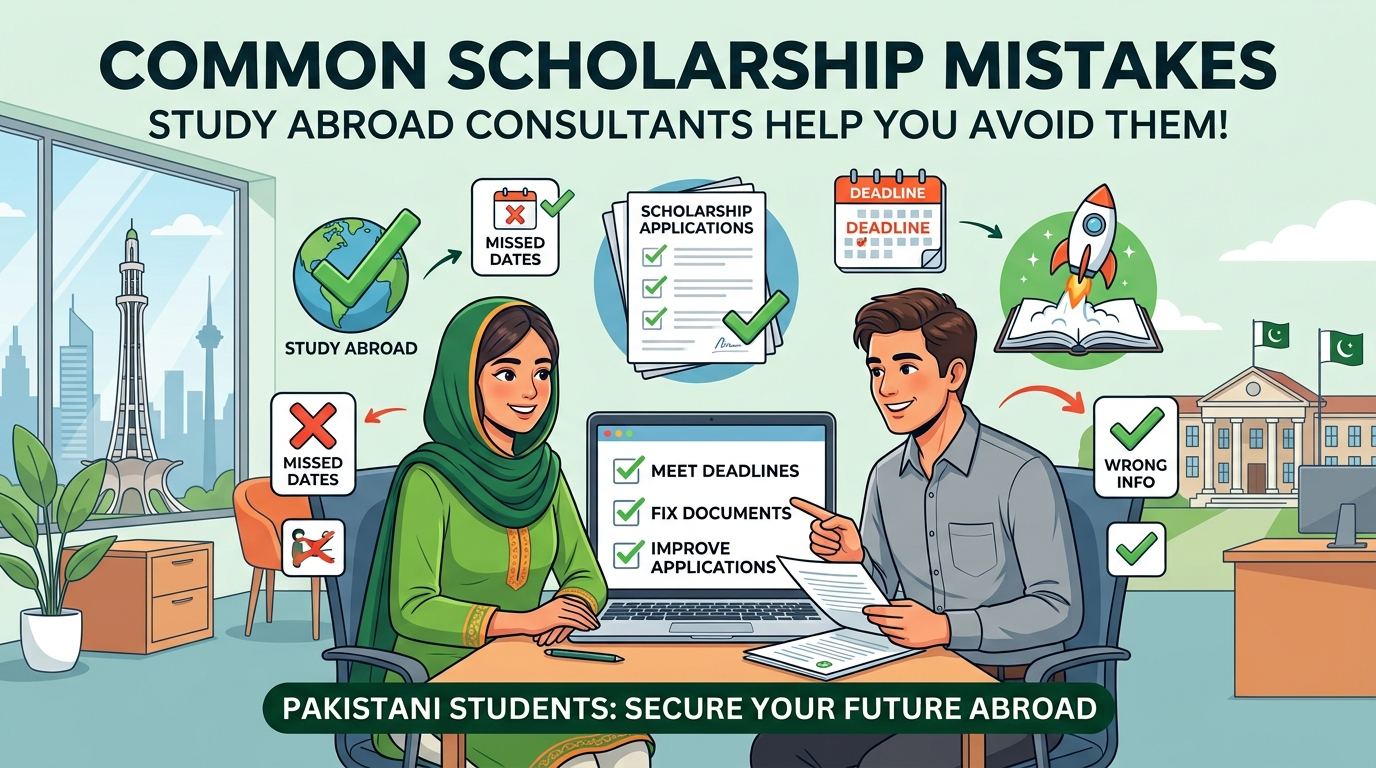
Common scholarship mistakes like missed deadlines, incomplete files, and recycled essays cause the bulk of rejections. A study abroad consultant catches those errors before you press submit.

International education costs more every year for Pakistani students. Tuition rises abroad while the rupee loses ground at home. Scholarships close that gap for thousands of families.

Competition for international student scholarships stays fierce as a result. Talent is rarely the barrier, but poor timeline management and administrative oversights frequently sink otherwise strong applications.

A missing attestation can end a file on day one. A deadline read in the wrong time zone does the same damage. Professional study abroad consultants protect applications from errors of exactly that kind. Here are the most common scholarship mistakes that cost Pakistani students money and the systems that remove them.

The Cost of Disorganization and Poor Documentation

Fix your timeline first, keeping in mind that true profile building and document gathering require months of advance planning.

Scholarship portals close on a fixed date and time. Most run on the local clock of the university, not Pakistan Standard Time. Students lose funding for a few hours every single year. Late applications rarely get a second look, and formal appeals for missed deadlines are almost universally rejected by funding bodies.

Incomplete scholarship applications fail just as fast. Reviewers work through hundreds of files and skip anything missing a required document. Pakistani applicants stumble most often on attestation and translation. HEC attestation takes weeks to complete. Some universities also want documents attested by the Ministry of Foreign Affairs or the relevant embassy.

Financial need documentation causes its own trouble. Funding bodies want proof that your family cannot pay the full fee. They also want proof that the money in the account genuinely belongs to your sponsor. Sudden large deposits raise questions that a bank letter cannot always answer.

Document Common mistake The time you should allow
HEC degree attestation Started only after the portal opens 4 to 8 weeks
Transcript translation Uncertified or unofficial copies submitted 2 to 4 weeks
IELTS or TOEFL report Test booked too close to the deadline 6 to 10 weeks
Sponsor bank statements Large fresh deposits with no account history 3 to 6 months of history
Recommendation letters Requested one week before submission 3 to 4 weeks

A consultant works from a compliance and document checklist built for each country. While administrative requirements are standardized to avoid errors, the strategy remains entirely unique to the applicant. That discipline alone rescues most applications that would otherwise fail on paperwork.

Why One-Size-Fits-All Applications Get Disqualified

Rebuild every application around the specific award, because identical files trigger scholarship disqualification fast.

Students often apply to twenty scholarships from one saved folder. Eligibility rules differ across the USA, the UK, Australia, and Europe. Some awards serve one region only. Others fund a single degree level or a specific field of study. Applying outside those limits wastes weeks and ends the file instantly.

Funding bodies also reward alignment. Every scholarship exists for a reason. Some fund future researchers. Some fund community leaders. Some support students from specific provinces or income brackets. Your application has to prove that you match that purpose.

Watch for these traps.

  • Applying for a master’s award while still finishing a bachelor’s degree
  • Ignoring nationality or residency limits written into the terms
  • Sending a research proposal that no faculty member at the university can supervise
  • Reusing an essay that still names the wrong university
  • Missing a required interview because the invitation went to an unused email address

Academic profile building solves the deeper problem. Strong candidates gather evidence over years, not weeks. Volunteering, research assistance, competitions, and internships all feed a customized scholarship strategy. Consultants map that plan early, often two years before the first application opens.

The Essay Trap and How to Fix Weak Content

Write a fresh essay for every award, because committees use that essay to separate equally qualified students.

Grades get candidates onto the shortlist. Essays decide who actually wins. Weak personal statements share the same habits. Many open with a famous quotation. Many describe a childhood dream in vague language. Many achievements are already visible on the transcript.

Plagiarism carries the heaviest penalty of all. Universities scan submissions with detection software and now flag machine-written text as well. A flagged essay can end your relationship with that institution permanently. Simple carelessness costs money too. Spelling errors, broken formatting, and ignored word counts all signal low effort to a tired reviewer.

Weak recommendation letters fail for a similar reason. A professor who writes three generic paragraphs helps nobody. Give your referee your CV, your goals, and a reminder of the specific work you did in their course.

A strong scholarship essay does four things.

  • Answers the exact question the funding body asked
  • Tell one specific story with real detail instead of general praise
  • Connects your goals to the stated mission of the scholarship
  • Explains what you plan to bring back to Pakistan afterwards

Professional scholarship essay editing, structural review, and brainstorming support turn a flat draft into a competitive one. Ethical consultants never write your essay for you; they guide you to sharpen your own authentic voice. A second reader catches what you stopped seeing on the fourth rewrite.

From Funding to Flights with Full Consultancy Support

Plan the whole journey now, because winning the award is only the first stage of the process.

Scholarship money arrives with conditions attached. Most awards require a minimum GPA and full-time enrollment. Some require progress reports every semester. Students lose funding halfway through a degree by ignoring those terms. Ongoing scholarship application support keeps renewal on track and flags problems early.

The visa stage trips up many funded students. Embassies want proof of finances, genuine study intent, and clear ties to Pakistan. Your interview answers must match the documents in your file exactly. Reliable student visa guidance prepares you for both halves of that test.

Travel and arrival need planning as well. Accommodation, health cover, airport pickup, and the first month of living costs need to be arranged. Good education consultancy services handle that sequence with you. An online education consultancy suits students in smaller cities. A physical office suits families who prefer meeting face-to-face.

Which Questions to Ask Before Hiring a Consultant

Ask about outcomes before you pay anything, because a good consultant answers plainly and a weak one changes the subject.

Pakistan has thousands of education agencies, and the quality varies. Some hold official representation with foreign universities. Others forward your documents and hope for the best. A short conversation separates the two groups.

  • Which universities and scholarship bodies do you hold official representation with
  • How many students did you place on funded seats last year
  • Who reviews my essay, and how many rounds of feedback do I get
  • What exactly does the fee cover, and what costs extra later
  • Will one case manager stay with my file from start to finish

Ask for the answers in writing. Any agency that refuses a written scope of work deserves a second thought. Compare two or three offices before you commit your documents and your money.

Secure Your Future with ATWICS Group

Foreign university portals confuse even confident students. You do not have to work through them alone. ATWICS Group serves students across Pakistan as a study abroad consultant and visa consultant. Our team covers university selection, scholarship applications, essay review, and visa preparation.

You can meet us in Faisalabad, Islamabad, Rawalpindi, Lahore, and Sialkot. Our regional offices also support families in Abu Dhabi. Visit ATWICS Group to book your free assessment. Fix these mistakes while your deadlines are still ahead of you.

August 21, 2026

Study abroad consultants do help with scholarships. They help in a way most students do not expect. No consultant can hand you a Chevening award. A good one only helps you polish your profile and papers, but you must apply yourself, and Chevening does not endorse any paid consultant.

Money sits at the front of every study plan made in Pakistan. Tuition abroad is priced in pounds, dollars, and euros. The exchange rate turns a normal fee into a frightening number for most families.

So the real question is not whether an agent can find you free money. The question is where an agent adds value and where you should do the work yourself. This guide is written by the team at ATWICS Group. We have kept it honest so you can decide what to do yourself and where we can help.

Decoding the Funding Landscape: What Are Your Options?

International student scholarships are split into a few clear types. Knowing the type tells you who to ask and when to apply.

Fully funded and partial scholarships

  • Fully funded scholarships cover tuition fee waivers plus monthly living stipends. Some add flights, visa fees, and health cover. Chevening and Fulbright sit in this group.
  • Partial scholarships cover a share of the tuition and nothing else. A 30 percent cut still leaves you paying for rent, food, and travel.

Most students chase the fully funded list and ignore the partial one. That is a costly habit. Sometimes two partial awards can be combined, but only if both scholarships allow it. Always check the terms before assuming you can stack them.

Merit based and need based awards

  • Merit-based scholarships reward strong grades, high IELTS scores, research work, or sporting achievement.
  • Need-based scholarships look at family income and financial background. Universities in the United States use these far more than universities in the United Kingdom.

Check which type you are applying for before you write a single word. The evidence each one demands is completely different.

Assistantships and departmental funding

Postgraduate students have a third route that many people miss. Departments hire their own students as teaching or research assistants. The role usually pays a stipend and waives part of the tuition.

These posts are advertised inside the department rather than on a national portal. You often apply by writing to a professor whose research matches yours. Start those emails early, because most funded posts fill months before the course begins.

The “Big Five” Government Grants vs. University Bursaries

Consultants are strongest on university funding. Government grants stay in your own hands.

Government grants come from a country’s public budget. The Chevening scholarship in the UK, the Fulbright program in the USA, the DAAD scholarship in Germany, Commonwealth scholarships, and MEXT in Japan all work this way. Each one runs on independent scholarship applications through an official portal. No agent can submit for you, and any agent who claims otherwise is selling a story.

Expert counselors still add real value here. They review your documents, sharpen your essays, and keep you on the deadline calendar.

University funding works differently. Universities set their own budgets, and they often share information with partner agents first. A consultancy with direct university networks can move quickly on university-specific bursaries and graduate research assistantships.

Point of comparison Government grants University bursaries
Examples Chevening, Fulbright, DAAD, Commonwealth, MEXT Dean’s awards, merit scholarships, graduate research assistantships
Who decides A government body or embassy panel The university department or admissions office
How you apply Independent scholarship applications on an official portal Usually through your admission file or a partner agent
Typical value Full tuition plus a living stipend Ten to fifty percent of tuition
Competition Very high, thousands of applicants for each seat Moderate, limited to that university’s applicant pool
Best use of a consultant Document review, SOP drafts, interview practice Shortlisting, direct university contact, deadline control
Timeline Opens roughly a year before study begins Rolling, tied to admission deadlines

How a Professional Consultant Adds Value to the Scholarship Application Process

A consultant improves your odds by improving your file. Three areas make the biggest difference.

Profile evaluation

Every strong application starts with an honest audit. A counselor reviews your transcripts, test scores, work history, and extracurricular record. Then they match you to universities where your profile has a real chance of funding.

Students lose whole seasons applying to places that were never going to pay for them. A proper profile evaluation stops that waste in week one.

Document mastery

The statement of purpose carries more weight than any other document in your file. Committees read hundreds of them, and a generic essay goes straight to the reject pile.

Good consultants push you through several drafts. They also brief your referees so recommendation letters say something specific instead of something polite. SOP editing is a craft and not a spell check.

Interview preparation

Chevening, Fulbright, and many university panels interview shortlisted candidates. Mock interviews expose weak answers before the real panel hears them. Practice sessions also fix pace, tone, and eye contact on video calls.

At ATWICS Group our expert counselors run this process end to end. Students receive personalized financial aid guidance, honest profile feedback, and document refinement until the file reads clean.

The Business Side: Commission-Based Recruitment vs. Consultancy Fees

You deserve to know how the money moves. The education consultancy industry runs on two models.

Commission-based recruitment

Universities pay third-party agents for every student who enrolls and stays. The student pays nothing for that service. The commission comes out of the university’s own recruitment budget.

Direct education consultancy fees

Students pay the consultancy when a case needs extra work. Common examples include non-partner university applications, dedicated SOP writing, complex visa histories, and profile building across a full year.

Ask which model applies to you in the first meeting. A transparent consultancy will answer plainly and show the fee structure in writing.

Now for the cost vs savings analysis. A consultancy fee can be small compared to a tuition waiver, but only if the waiver actually comes through. There is no guarantee. Careful study abroad budget planning also protects you from a refused visa and a lost tuition deposit.

Watch for these warning signs.

  • Any guarantee of a scholarship or a visa
  • Pressure to apply to only one or two partner universities
  • Refusal to put the fee structure on paper
  • Advice to inflate a bank balance or edit a document

Beyond the Scholarship: University Admissions and Student Visa Assistance

Funding is only half the journey. A scholarship letter does not put you on the plane.

University admissions come first. Offer letters, conditional requirements, English test scores, and deposit deadlines all need tracking. Miss one date and the plan slips by a full semester.

Then comes the visa. Pakistani passport holders face heavy scrutiny on financial documents. Embassies check bank statements, sponsor income, tax returns, and the source of every large deposit.

Accurate visa paperwork matters most at this stage. We guide you on the documents, but for full legal visa advice you should also speak to a licensed immigration adviser. Your funding evidence, your admission letter, and your bank records must tell one story. Any gap between them invites a refusal, and a refusal follows you into future applications.

A scholarship also changes how much money you must prove. Some embassies reduce the required maintenance amount when an award covers tuition. You should calculate that figure against the current rules. If you are unsure, speak to a licensed immigration adviser.

Why ATWICS Group is Your Trusted Partner in Pakistan

ATWICS Group joins admission, funding, and visa guidance into one process. A single team tracks your case from the first profile review to the visa stamp. Nothing falls through a gap between departments.

Our team works closely on each file from start to finish. We focus on detail because one small mistake can cost a whole year. We know which universities fund Pakistani applicants and what each embassy wants to see.

Students meet us face to face as well. Our main hub sits in Faisalabad, with offices in Islamabad, Rawalpindi, Lahore, and Sialkot.

Book a free initial profile assessment with ATWICS Group. Bring your transcripts and your test scores. We will tell you honestly where your funding chances stand.

August 18, 2026

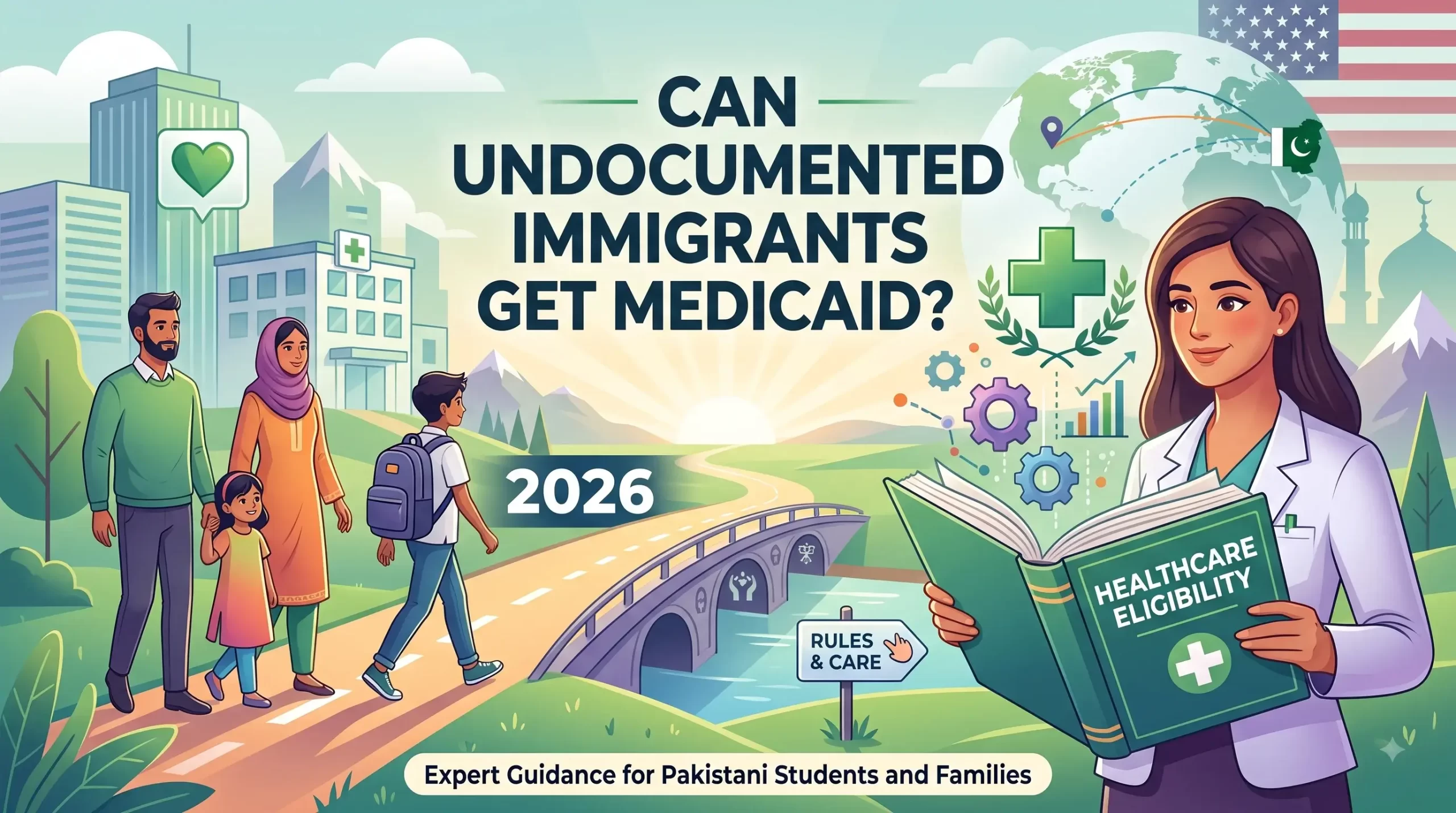
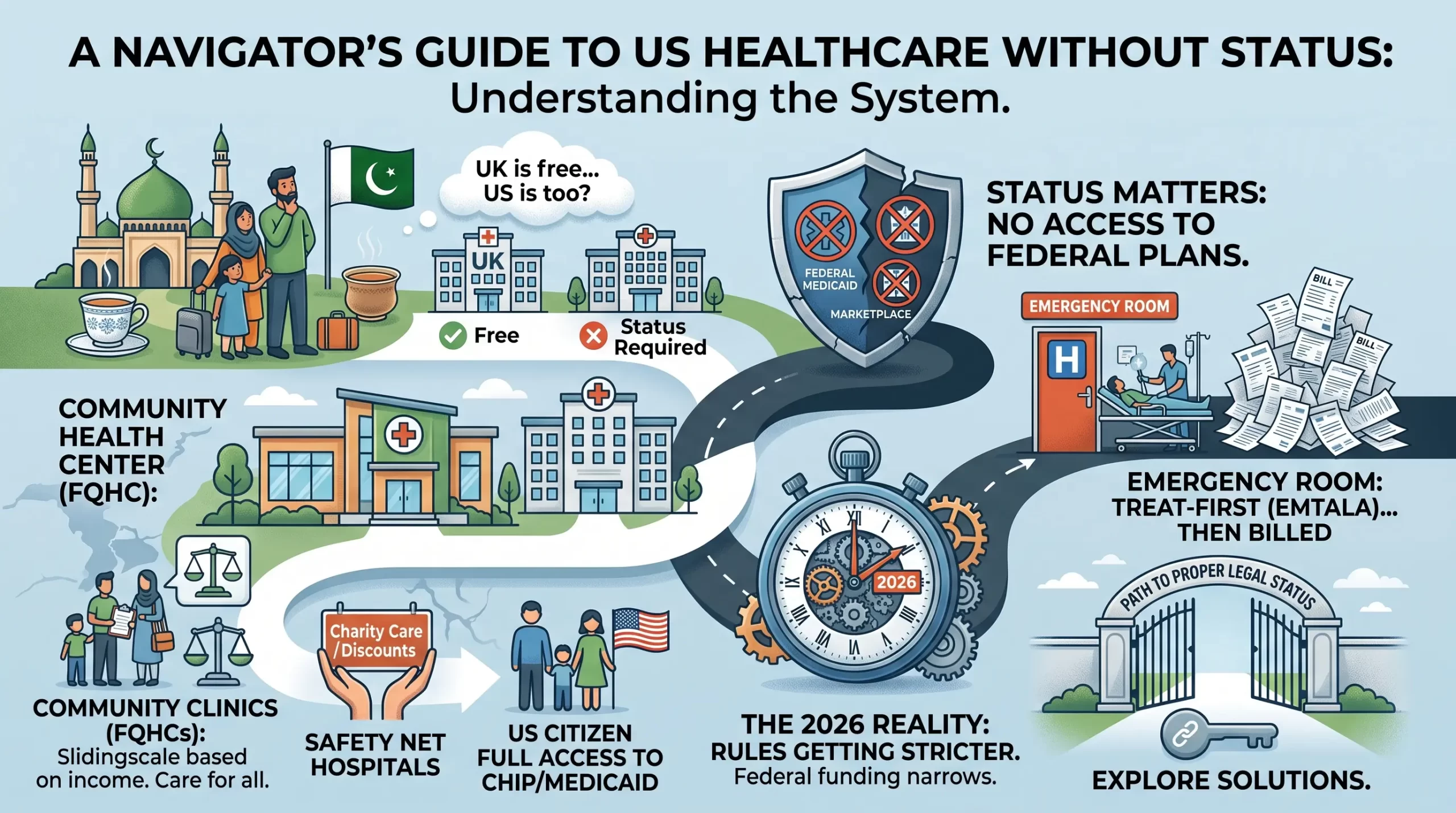
Undocumented immigrants do not get free healthcare in the United States. Federal law shuts them out of Medicaid, Medicare, and marketplace insurance plans. Emergency rooms must still treat them, but the hospital sends a bill afterwards.

Many families in Pakistan assume America works like the United Kingdom. That assumption costs people a lot of money. American healthcare runs on private insurance. Even US citizens pay a premium every month. One night in a hospital can cost thousands of dollars without cover.

That gap matters if you plan to move. Life without legal status means life without a health safety net. At ATWICS Group, our business immigration consultants and visa consultants push clients toward proper legal status. Legal status protects both your health and your savings.

The Truth About Medicaid Eligibility and Federal Bans

Traditional Medicaid stays closed to anyone without a qualified immigration status. Income does not change that. Years spent living in the country do not change it either.

Medicaid is a joint federal and state program for low-income residents. To qualify, you need what the law calls a qualified status. The list covers green card holders, refugees, people granted asylum, and a few smaller groups. Undocumented people never appear on it.

The Affordable Care Act works the same way. Anyone without legal status is barred from the health insurance marketplace. They cannot buy a plan there even at full price with their own money.

Paying taxes does not create eligibility

Millions of undocumented workers file taxes each year using an ITIN number. Those payments fund Medicaid and Medicare for everyone else. The workers themselves still get nothing back from either program.

That surprises a lot of people. Tax records help with some immigration cases later, so keep them. They will not buy you a health plan today.

The five-year waiting period

Legal status alone does not open the door. Most adults who receive a green card must wait five years before they can claim full Medicaid.

Some groups skip that wait. Refugees, asylum grantees, and certain military families qualify straight away. Many states also cover lawfully present children and pregnant women without the delay.

Status Full Medicaid Marketplace plan Emergency care
US citizen Yes, if income qualifies Yes Yes
Green card holder Yes, usually after a five-year wait Yes Yes
Work or student visa holder No Yes, though subsidies end in January 2027 Yes
Undocumented immigrant No No Yes, under EMTALA

What Happens in a Medical Crisis? EMTALA and Emergency Medicaid

An emergency room must treat you. The treatment is not free.

A federal law called EMTALA sets that rule. Every hospital emergency department that accepts Medicare has to screen each patient who walks in. If the patient has an emergency condition, staff must stabilize the patient before anything else. Nobody may ask about immigration status or insurance first.

EMTALA forces the treatment but says nothing about who pays for it. Once you are stable, the hospital bills you for the full cost.

Emergency Medicaid softens that blow in some cases. The program pays the hospital directly for stabilizing an urgent condition. Patients never receive an insurance card, so the help stops at the hospital door.

What Emergency Medicaid Covers

Emergency Medicaid usually covers the following:

  • Sudden and severe events such as a heart attack, a stroke, or a serious accident
  • Labor and delivery
  • The care needed to stabilize the patient, and nothing past that point

What Emergency Medicaid Does Not Cover

Emergency Medicaid usually leaves out the following:

  • Routine checkups and preventative care
  • Long-term treatment for cancer or kidney failure in many states
  • Medicines prescribed after discharge
  • Dental care, eye care, and vaccinations

Alternative Health Coverage Options for the Uninsured

Community health centers handle most routine care for uninsured people. These clinics are the practical answer when insurance is off the table.

Federally Qualified Health Centers (FQHCs)

Federally Qualified Health Centers, known as FQHCs, run thousands of sites across the country. They treat every patient regardless of immigration status. Staff ask about your income, not about your papers.

Sliding Fee Scale

Care there is low cost rather than free. Clinics use a sliding fee scale, so your bill depends on household income and family size. A working family on a small wage may pay a flat fee of a few dollars per visit.

Healthcare Services Available

These centers usually offer the services below:

  • Primary care and long-term illness checkups
  • Prenatal visits and child health services
  • Basic lab tests and screenings
  • Mental health support and dental care at many sites

Safety Net Hospitals

Safety net hospitals fill the next gap. Most nonprofit hospitals must run a written financial assistance policy, often called charity care. Patients can apply for a discount or a full write-off of the bill.

Ask for the Financial Assistance Policy

Ask for that policy in writing on the day you receive treatment. Hospitals rarely mention it, and the application window can close once the bill reaches a collection agency.

Free Clinics and Pharmacy Discount Cards

Charity-run free clinics and pharmacy discount cards cover the rest. None of these options add up to real insurance. They keep a family going until proper coverage becomes possible.

Protecting Children and Navigating Mixed-Status Families

A US citizen child keeps full access to public health programs even when the parents lack status. Eligibility follows the child, not the parent.

Children born in the United States qualify for Medicaid and the Children’s Health Insurance Program. They apply on the same terms as any other citizen. CHIP exists for families who earn too much for Medicaid but too little for private insurance.

Fear of the public charge rule stops many parents from applying. That fear is mostly misplaced. Health benefits used by a citizen child are not counted against a parent’s future green card case. Officers review the applicant’s own record.

Several states go further and fund health programs for children regardless of status. Coverage varies a lot by state, so check local rules before you assume anything. A family in California faces a very different picture from a family in Texas.

The 2026 Healthcare Rules: What You Need to Know

The rules get stricter from October 2026 onward. The One Big Beautiful Bill Act, signed in July 2025, reshapes who receives taxpayer-funded care.

Three dates matter most for anyone planning a move.

  • 1 October 2026. Federal support for Emergency Medicaid drops. Washington cuts its share from 90% to the state’s normal rate, which can fall as low as 50 percent. States must cover the difference, so many will tighten the program.
  • 1 October 2026. Federal Medicaid and CHIP funding narrows to a shorter list of immigration statuses. Several lawfully present groups lose their access.
  • 1 January 2027. Marketplace subsidies shrink to green card holders, certain Cuban and Haitian entrants, and citizens of Compact of Free Association nations. Refugees, asylum grantees, TPS holders, and many visa holders drop off the list.

The message is simple for Pakistani applicants. Your visa category now decides your healthcare access more than your income does.

Secure Your Future with Expert Guidance

Emergency rooms and charity clinics keep people alive. They do not keep a family healthy for twenty years. Nobody should build a life in America around a hospital of last resort.

Real health coverage in the United States follows legal status. A green card, an approved work visa, or an investor route opens the door. You gain access to employer plans, marketplace plans, and public programs.

That is where good planning pays for itself. Your immigration route shapes your healthcare, your taxes, and your peace of mind.

Speak to the team at ATWICS Group before you commit to a plan. Our consultants map your options, prepare your file, and keep your status clean from day one. Explore our tailored visa solutions and start the journey safely.

August 11, 2026

Undocumented immigrants cannot enroll in full Medicaid. Federal law closes that door completely. Emergency treatment is open to everyone. A few states pay for extra coverage from their own budgets.

Moving from Pakistan to the United States changes everything about daily life. Most students focus on the admission letter and the visa interview. Healthcare rarely enters the plan until a bill arrives. The United States runs no universal health system.

People pay for care through private insurance, an employer plan, or a public program. Medicaid sits at the center of that public safety net. Access to Medicaid depends almost entirely on immigration status. Undocumented immigrants stay locked out of federally funded coverage. Even lawful residents wait years before they qualify.

At ATWICS Group, we tell every client the same thing. Clean legal status protects your health as much as your career. Here is how the system works in 2026.

Federal Rules and Why Legal Status Decides Everything

Check your status first, because your status controls access to every federal health program in the country.

Federal law sorts non-citizens into narrow categories. Only a short list of groups qualifies for federally funded care. People without lawful status fall outside every one of those groups. They cannot enroll in Medicaid. They cannot enroll in Medicare. They also cannot buy a plan on the ACA Marketplace, even with their own money at full price.

Lawfully present immigrants face rules too. Most green card holders wait five years before full Medicaid opens to them. Student visa holders and work visa holders cannot get Medicaid or CHIP. However, they can still buy ACA Marketplace plans. They keep premium tax credits through the end of 2026 and unsubsidized Marketplace plans after that. Universities and employers often cover them through private plans, but the federal Marketplace is not closed to them. Proper visa status remains the gateway to every other option. Our team at ATWICS Group builds each application around that fact.

Program Who can enroll Position of undocumented immigrants
Full Medicaid Citizens and certain green card holders Barred
Medicare Citizens and qualified immigrants with work credits Barred
ACA Marketplace plans Citizens and lawfully present immigrants Cannot buy at any price
Emergency Medicaid Anyone who meets state income rules Covered for emergencies only
Community health centers Open to all local residents Available on a sliding fee scale

What Happens During a Medical Emergency

Go to the emergency room anyway. Hospitals must treat you however your paperwork says.

A federal law called EMTALA governs this. Every emergency department that accepts Medicare funding must screen anyone who walks in. Staff must stabilize the patient before discharge or transfer. Nobody at the front desk asks about your visa first.

Emergency Medicaid then pays part of that bill. The program covers unauthorized non-citizens who meet the normal income limits. Coverage stops once the emergency ends.

Emergency Medicaid usually pays for the following care.

  • Treatment for sudden and serious medical conditions
  • Life-saving surgery and hospital stabilisation
  • Labor and delivery for pregnant women
  • Follow-up care tied directly to the emergency event

Coverage for Children and State-Funded Programs

Check your destination state closely. Several states cover children and pregnant women even when federal rules say no.

States run their own health budgets alongside the federal system. Some use that freedom to widen access. State-funded programs pay for children regardless of status in a handful of places. Rules shift with each state legislature, so the answer changes by address.

CHIP protects children in families that earn too much for Medicaid and too little for private plans. Two federal options let states go further. ICHIA and CHIPRA 214 allow a state to waive the five-year waiting period. Lawfully residing children and pregnant women then get coverage straight away. More than thirty states use at least one of those options.

Budgets shift as well. California opened state-funded Medi-Cal to undocumented adults, then paused new enrollments starting January 1, 2026. People already enrolled can stay covered if they complete their annual renewal on time. The program is frozen for newcomers, not shut down for everyone. Treat any state benefit as a moving target rather than a guarantee.

Mixed Status Families and Green Card Holders

Apply for your citizen child with confidence. A US citizen child keeps full Medicaid rights even when a parent has no status.

Many families avoid applying out of fear. Parents worry that a Medicaid form will trigger an immigration case. The public charge rule feeds the worries every year. Health agencies verify the status of the applicant only. A citizen child applying for Medicaid does not expose the immigration file of a parent.

Green card holders face a different hurdle. Most wait five years after receiving the card before full federal Medicaid opens to them. Refugees and asylees who later become green card holders still skip the five-year wait. The 2026 rules do not change that. H.R. 1 only removes Medicaid and CHIP for refugees and asylees who are not yet green card holders. Once they adjust to lawful permanent resident status, the five-year bar exemption stays the same as before.

Keep your record clean while you use the system.

  • Apply only for benefits your current status actually allows
  • Answer every question on the form truthfully
  • Keep copies of approvals, denials, and hospital bills
  • Ask a licensed immigration attorney before signing anything you do not understand

Careful navigation today protects green card and visa renewals later.

The 2026 Rule Changes Every Immigrant Family Should Track

Mark three dates on your calendar. Medicare restrictions for new applicants began on July 4, 2025. Medicaid and CHIP restrictions for refugees, asylees, and parolees begin on October 1, 2026. ACA Marketplace subsidies for most immigrants end on January 1, 2027. Each program has its own deadline.

The One Big Beautiful Bill Act became law in July 2025. Section 71109 rewrote the list of immigrants eligible for federally funded Medicaid and CHIP. The same section applies to both programs, to the same shorter list.

Group Position from 1 October 2026
US citizens Still eligible
Certain lawful permanent residents Still eligible
Cuban and Haitian entrants Still eligible
COFA citizens Still eligible
Refugees and asylees Lose federal Medicaid and CHIP
Humanitarian parolees Lose federal Medicaid and CHIP
Survivors of trafficking and abuse Lose federal Medicaid and CHIP
Undocumented immigrants Emergency Medicaid only, as before

Emergency care survives the cut. The law also lowers the federal match for Emergency Medicaid in Medicaid expansion states. In those states, the federal share drops from 90 percent down to the state’s regular matching rate, which can be as low as 50 percent. That may push some expansion states to cut back on emergency services for undocumented immigrants. Humanitarian status no longer guarantees healthcare in the United States, which makes a planned and lawful route more valuable than ever.

Plan Your Move the Right Way with ATWICS Group

American healthcare punishes weak paperwork. Your visa file decides which door opens when you fall ill. Students, professionals, and families from Pakistan all need the same foundation, which is an honest and complete application from day one.

ATWICS Group builds that foundation for you. Our study abroad consultants and visa experts handle admissions, documentation, and interview preparation. One team follows your file from the first assessment to the day you land.

You can meet us in Lahore, Islamabad, Rawalpindi, and Sialkot. Our Faisalabad branch operates at Regent Mall. Contact ATWICS Group and book your free consultation today.

FAQs

Can a non-US citizen qualify for Medicaid?

Many can. Green card holders qualify after a five-year wait in most states. Certain groups skip that wait. The 2026 rules shrink that list sharply. Student and tourist visa holders receive no federal Medicaid at all.

What is the difference between an illegal immigrant and an undocumented immigrant?

Both terms describe the same legal position. Undocumented is the wording used by hospitals, universities, and most benefit agencies. Older statutes still use harsher language in places, though the eligibility rules stay identical.

Can undocumented immigrants apply for Medicaid in the US?

Full Medicaid stays closed to them. They may still apply for Emergency Medicaid and use community health centers. They can also apply on behalf of a child who holds US citizenship.

What is Emergency Medicaid, and who can use it?

Emergency Medicaid pays hospital costs for sudden and serious conditions. Anyone who meets the income rules of their state can use it, regardless of their immigration status. Coverage ends as soon as the emergency ends.

How do the 2026 Medicaid rules affect immigrants?

From 1 October 2026, refugees and parolees lose federal Medicaid and CHIP. Citizens, certain green card holders, Cuban and Haitian entrants, and COFA citizens keep their coverage. Emergency care continues for everyone.

Quick Assessment
close slider