Hi, How Can We Help You?
June 17, 2026

A name mismatch between your passport and NADRA card can get your visa refused. An unexplained bank deposit can do the same. Embassy scrutiny has tightened in 2026. Pakistani applicants face more document checks than at any point before.

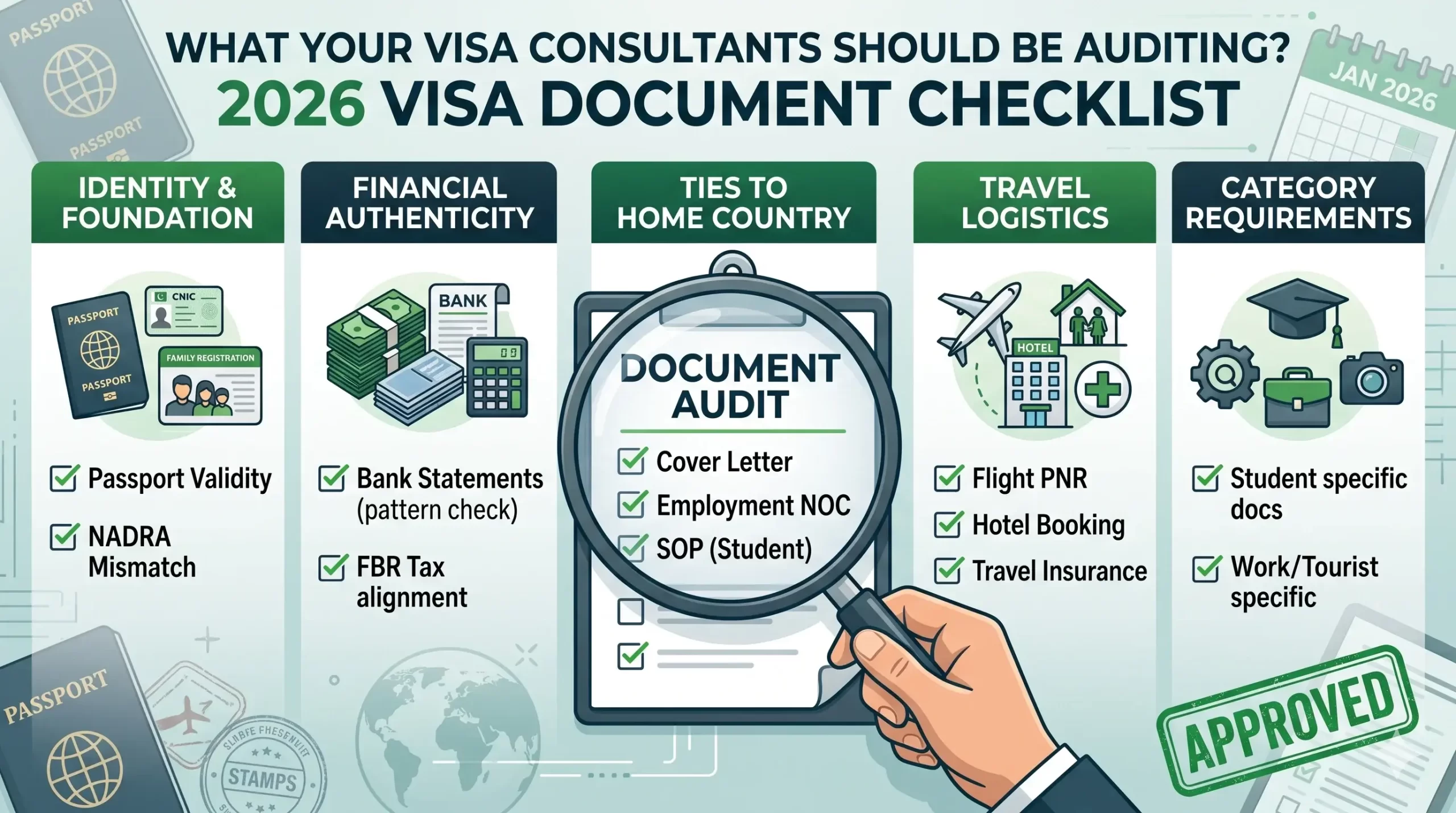
Submitting a clean file is not optional. It is the minimum requirement. Professional visa consultants do not just fill out forms. They run a structured document audit across every phase of your file.

This checklist shows exactly what that audit should cover.

Phase What Gets Audited Common Failure Point
1. Identity and Foundation Passport, CNIC, FRC, NADRA records Name or date of birth mismatch across documents
2. Financial Authenticity Bank statements, FBR returns, sponsor letters Unexplained deposits or income discrepancies
3. Ties to Home Country Cover letter, Employment NOC, Statement of Purpose Vague NOC or missing cover letter
4. Travel Logistics Flight reservation, hotel booking, insurance Invalid PNR or wrong insurance coverage
5. Category Requirements Student, work, or tourist-specific documents Wrong attestation or missing program letters

Phase 1: Identity and Foundation Audit

Every visa application starts with proving who you are. If your consultant treats this phase as a formality, it is alarming.

Passport validity

Most embassies require at least six months of remaining validity from your travel date. Some countries count from the return date, not the departure date. UAE and Schengen states both follow this rule. Your consultant should check the validity rules for your specific destination.

If your passport was recently renewed, some embassies ask for the old one too. A gap in travel history becomes a question in your file.

NADRA cross-referencing

Your CNIC, Family Registration Certificate, and passport must carry the same name, spelling, and date of birth. A Muhammad on one document and Mohammad on another will make trouble.

Your consultant should cross-reference every foundational document before anything else. If there is a mismatch, the fix starts with NADRA: update the CNIC or NICOP first, then apply for a modified passport. You cannot fix a passport spelling with an affidavit alone. NADRA updates take four to six weeks. Start this process before anything else.

Phase 2: Financial Authenticity

Embassies scrutinize Pakistani financial documents more closely than almost any other part of the file. There is no room for shortcuts here.

Bank statements

A stamped bank statement from the last six months is the baseline. The baseline alone will not protect you. Embassy officers look at the pattern, not just the final balance. Steady income with consistent deposits reads very differently from a dormant account.

If someone transferred money into your account to boost the balance, your consultant must prepare an explanation. An unexplained PKR 2 million deposit is the fastest way to get a refusal.

FBR tax returns and income alignment

Your income tax returns must match your bank statements. Your FBR filing and bank statements must match. If FBR shows PKR 1.2 million annually but your bank shows PKR 3 million, the embassy sees a discrepancy.

Your consultant should reconcile these figures before submission. Finding the gap after a refusal is too late. When they do not match, the consultant must document the source of every deposit over twenty-five percent of monthly declared income. Request a source-of-funds letter.

Check withdrawal patterns to see if the money leaves as quickly as it arrives. Separate personal and business flows using business bank statements, trade licenses, and NTN records. If family members contributed funds, include relationship proof and the sponsor’s own financial trail. Do not submit until every gap has a paper explanation.

Sponsor letters

A sponsor letter alone is not enough. The sponsor’s own bank statements, tax documents, relationship proof, and a written undertaking must all be included. Embassies reject sponsor backed applications when the sponsor’s financial standing is not documented.

Phase 3: Proving You Will Come Back

This is where most Pakistani visa applications succeed or fail. Every document in this phase answers one question: what brings this person home?

Cover letter

A visa cover letter summarizes your trip, your finances, and the documents that support your case. It should be one page. State your purpose directly. End with your name.

Most applicants skip it or write something vague. That is a missed opportunity. A clear cover letter frames your entire file before the officer reads a single bank statement.

Employment NOC

The no objection certificate from your employer confirms your salary, job title, and the leave dates you applied for. A vague line like “we have no objection” without that context is weak. The NOC should make it clear the company expects you back and has a reason to want you there.

For business owners, this means trade licenses, NTN certificates, and recent business bank activity. You are proving the business needs your presence, not just that you own it.

Statement of purpose (student visas)

The statement of purpose must show academic intent, not migration intent. It should explain why this specific program at this specific university connects directly to your career goals in Pakistan. A generic statement that could apply to any university in any country will not convince anyone.

Phase 4: Travel Logistics and Compliance

Trip details must be documented, verifiable, and aligned with the destination embassy’s rules. Weak logistics paperwork suggests a weak applicant.

Flight reservations

Do not buy a full-price ticket before your visa is approved. Embassies want a flight reservation with a valid PNR number they can verify online. Most travel agents offer conditional booking options. They hold your seat without full payment. Your consultant should arrange this so you have a verifiable booking without risk.

Hotel booking or host invitation

Book a hotel with a flexible cancellation policy. If you are staying with a host, you need a formal invitation letter and the host’s ID or proof. Schengen applications sometimes require a notarized declaration from the host as well.

Travel medical insurance

Schengen visas require a minimum coverage of EUR 30,000. The policy must cover all Schengen states and the full duration of your stay. Your consultant should verify the insurer is accepted by the specific embassy. Some consulates reject policies from providers they have not vetted.

Phase 5: Category-Specific Visa Consultants Requirement

Generic checklists treat all visa types the same. Every category has its own document layer. What works for a tourist visa will not work for a student or work visa.

Document Student Visa Work Visa Tourist Visa
Admission letter CAS, I-20, or CoE required Not required Not required
Academic records HEC-attested transcripts and IBCC equivalence Experience letters from past employers Not required
Language test IELTS or PTE scores required Depends on destination Not required
Employer documents Not required Job offer and labor market proof NOC recommended
Financial proof Personal or sponsor funds Usually employer supported Personal bank statements
Travel history Helpful but not mandatory Helpful but not mandatory Strongly recommended

Student Visas

Student visa applications require a CAS letter for the UK, an I-20 for the US, or a CoE for Australia. Degree transcripts must be attested by HEC. Intermediate certificates need IBCC equivalence. IELTS or PTE scores must meet the program’s stated requirement, not just the general country minimum.

If your academic gap is over two years, include a written explanation. Embassies flag gaps and question whether the intent is genuinely academic.

Work visas

A job offer letter is just the starting point. Work visa files require labor market testing proof from the employer, verified experience letters from previous positions, and qualification attestation. Your consultant should confirm that the job offer matches the destination country’s specific occupation list for that visa stream.

Tourist and visit visas

A strong tourist visa application includes prior travel history and documented ties to Pakistan. First-time travelers with no stamp history face extra scrutiny. Your consultant should strengthen the file with property documents, business ownership records, or family dependency evidence.

Conclusion 

Embassy standards do not become more lenient over time. They become more specific. A document audit before submission finds the problems the embassy would otherwise find for you.

At ATWICS Group, dedicated case managers run a structured audit across every phase in this checklist. Every document is reviewed against the latest embassy guidelines for your specific visa category. Contact ATWICS Group before your file reaches the embassy and get it done right the first time.

June 8, 2026

Pakistan has thousands of unregistered travel agents who call themselves immigration consultants. Most cannot represent you before any embassy.

The risk is not a wasted fee. A forged document, a mishandled passport, or a wrong application can ban you from a country for years. Asking the right questions of your consultant before you pay anything is the only real protection.

Ask these seven questions before you sign anything or hand over documents.

Question What You Are Testing
What is your official accreditation? Legal authority to represent you
What does your fee include? Hidden charges and transparency
What happens if my visa is rejected? Accountability after fees are paid
What is your passport retention policy? Risk of document being held as leverage
Who manages my case? Case continuity and quality
Can you guarantee my visa approval? Honesty versus fraud indicators
Can you show verified success rates? Real track record versus empty claims

Question 1: What Is Your Official Immigration Consultant Accreditation?

A registered consultant holds destination-specific accreditation. This authorizes them to prepare and submit applications on your behalf. An unregistered agent has no legal authority. They cannot represent you at any embassy.

Ask about accreditation for your target country:

  • Australia requires registration with the Migration Agents Registration Authority (MARA)
  • UK and Canada have their own regulatory bodies with verifiable databases

If a consultant cannot name their registration body, they are not registered.

Question 2: What Does Your Visa Consultation Fee Actually Include?

Hidden fees are among the most common complaints against Pakistani visa agents. Many applicants notice extra charges only when their file is ready to submit. At that point, refusing to pay risks losing the work already completed.

Before paying anything, ask for a written fee breakdown that differentiates:

  • The official embassy fee, which is fixed and non-negotiable
  • The agency consultation fee. This is where transparency either exists or does not

Also, ask for a signed service agreement before any money changes hands. It must list every charge, the full scope of work, and the refund terms.

Question 3: What Is Your Policy When a Visa Is Delayed or Rejected?

This question tells you whether the agency takes responsibility after collecting fees. Ask how they handle:

  • A visa refusal
  • Embassy administrative delays
  • A 221(g) administrative processing hold. This applies to US visa applicants only. It means the officer needs more documents or a security check before making a decision.

A competent visa consultant has a defined response for each of these situations. They do not improvise. Any agency that refuses to discuss rejection is hiding something. Any agency that guarantees approval to dodge the question is lying. Leave immediately.

Question 4: What Is Your Passport Retention Policy?

A legitimate consultant never holds your passport longer than the official submission requires. Keeping it beyond that point is a fraud signal. It creates leverage over the applicant and is used to demand extra payments.

A legal agency submits your passport to the official embassy drop-off point. They return it to you as soon as the embassy is done with it. At the time of handover, ask for:

  • A submission receipt
  • The tracking reference number

Your passport should not sit in a consultant’s office for weeks. There must be a submission record from the day you handed it over.

Question 5: How Do You Check My Profile and Who Manages My Case?

A qualified consultant reviews your documents first. This means your academic history, work record, finances, and travel history. Only then do they give you an honest assessment. An honest evaluation includes the possibility that you do not qualify at this stage. Some agencies promise results before seeing a single document. That is a sales pitch. It is not a consultation.

Ask two specific questions:

  • Ask if they review your actual documents before giving any advice. Ask if their assessment matches the specific requirements of your visa subclass.
  • Who manages your file day to day? One person should own your case from start to finish. A rotating team means no one is accountable. Results drop when no one knows your file.

Question 6: Can You Guarantee My Visa Will Be Approved?

No consultant in any country can guarantee a visa. The embassy officer makes the final decision. Any consultant promising 100% approval is either uninformed or misleading you.

The visa approval guarantee is always the mechanism used to extract inflated fees. Some consultants insert forged visa stamps into your application. They show you a fake approval. You get banned from the country, and the consultant keeps your money.

This triggers a permanent ban for the applicant, not the agent. If a consultant offers a guarantee, end the meeting.

Question 7: Can You Show Verifiable Success Rates and Real Client Testimonials?

Ask for the success rate for your visa subclass and destination country. Social media posts are not enough on their own. Ask for video testimonials from clients who have profiles like you.

You must also ask the agency to offer mock interview preparation opportunities. This is a specific, measurable service. Agencies that skip this step are offering form-filling, not real immigration consultancy.

What Unqualified Consultants Actually Cost You

Most applicants only discover problems after paying. By then, the damage is done. Common outcomes when hiring the wrong consultant:

  • Full fees paid with no refund after a visa rejection
  • Passport held for weeks with no submission record
  • Multi-year entry ban due to forged documents in your application
  • Agent stops responding after collecting money

Why a Physical Office Matters Before You Hand Over Any Documents

A digital agent is a risk you do not need to take. If they stop responding mid-process, you have no way to follow up. A physical office means:

  • You can meet your consultant face to face
  • You have a location to visit if something goes wrong
  • There is accountability beyond a phone number
Agencies like ATWICS Group have offices across major Pakistani cities and the UAE, for your easy access. Applicants can meet their assigned case manager in person at any stage of the process.
May 30, 2026

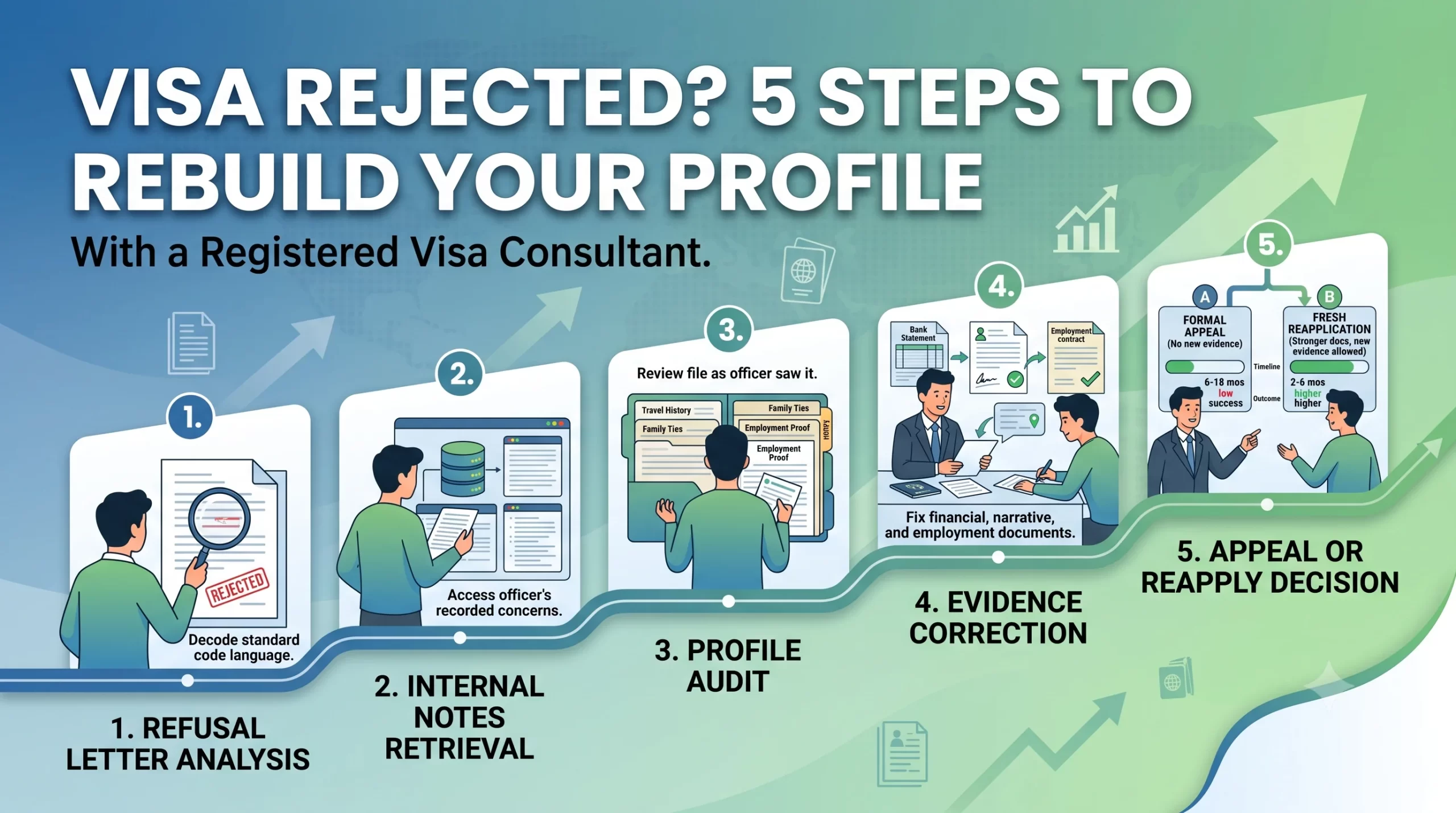
A visa refusal letter tells you about what the visa officer found unconvincing. Most Pakistani applicants treat it as a final verdict. But it is not. It is a documented list of fixable problems.

The most common mistake is reapplying with the same documents. A second submission with the same weaknesses almost always produces a second refusal. Two refusals on your record make the third application far harder to get.

A registered visa consultant does not just file paperwork. The consultant reads the refusal and finds the root cause. Then fix the weakest parts of your profile. The goal is a file the officer cannot reasonably doubt.

The five steps below show exactly how that works.

Step What Happens Why It Matters
1. Refusal Letter Analysis Decode the embassy’s standard code language Identifies the actual problem, not the surface complaint
2. Internal Notes Retrieval Access the officer’s recorded concerns Shows whether the issue is a document gap or a credibility flag
3. Profile Audit Review your file as the officer saw it Finds structural weaknesses you have not identified yourself
4. Evidence Correction Fix financial, narrative, and employment documents Removes the specific reason the first application failed
5. Appeal or Reapply Decision Choose the correct legal route The wrong choice wastes months and compounds your refusal record

Step 1: What Does the Refusal Letter Actually Say?

Pakistani embassies rarely write personalized rejection reasons. Most refusal letters use standard code phrases. Each phrase points to a specific documentation gap.

Common refusal phrases and what they mean:

  • Insufficient ties to home country: Means weak employment proof, no property records, or missing family dependency documents
  • Purpose of visit not established: Means your stated travel reason did not match your financial profile
  • Funds not sufficient or credible: Means your bank statements showed sudden deposits or inconsistent income
  • Intention to return not satisfied: Means your profile gave the officer no reason to believe you would leave

A registered visa consultant reads these phrases as clinical indicators. Without immigration training, you will misread them. That leads to fixing the wrong problem entirely.

Step 2: The Officer’s Internal Notes Hold the Real Answer

For Canada, the refusal letter is only a summary. The full decision is recorded inside the Global Case Management System. Visa officers use this system to record every concern about your file. Pakistani applicants have the legal right to request these notes.

A GCMS notes application shows:

  • Whether the refusal came from a missing document
  • Whether it came from a financial inconsistency
  • Whether it came from a deeper credibility problem
  • Whether a fraudulent agent submitted fabricated documents without your knowledge

That last point changes everything. If a fraudulent agent filed on your behalf, the case is a different problem. It needs a completely different strategy.

For countries other than Canada, a registered visa consultant submits freedom of information requests. These retrieve the officer’s documented reasoning through official channels. Without this step, any reapplication is still questionable.

Step 3: Profile Evaluation Reveals What the Officer Already Saw

A profile evaluation is a structured review of everything the officer examined. That includes:

  • Bank statements and savings history
  • Employment records and income proof
  • Travel history
  • Family situation and dependents
  • The match between your stated travel purpose and your documented reality

Most Pakistani applicants have at least one structural weakness they have not identified. Take a young professional with no prior international travel. Average bank balances and no property. That profile looks weak to a Canadian or Schengen officer. The officer is not judging your character. The officer is reading risk indicators.

A legal visa consultant maps your profile against the requirements for your visa category. Some gaps take weeks to fix. Others take months. Knowing the timeline stops premature reapplications. Those waste fees and add another refusal to your record.

Step 4: Fixing Weak Evidence Is Where Reapplications Win or Lose

If weak finances caused the refusal, adding money before reapplying does not fix the problem. Officers are trained to spot sudden large deposits with no history behind them. A credible financial profile shows:

  • Consistent monthly income
  • Regular savings movement over several months
  • A balance history that matches your stated profession

Statement of purpose (student visa)

A weak statement of purpose describes what you want to study. A strong one explains:

  • Why this specific program at this specific institution is the next step in your career
  • Why returning to Pakistan after graduation directly serves your professional future

Employer documentation (work visa)

Labour Market Impact Assessment documents, offer letters, and company registration proofs must form one consistent story. A registered visa consultant works directly with the overseas employer’s HR or legal team. This closes documentation gaps the applicant cannot identify alone.

Step 5: Appeal or Reapply

A formal appeal is only appropriate when the officer made a legal or procedural error. Appeals do not introduce new evidence. They argue the officer misapplied existing rules. For most Pakistani applicants, this is the slower and less successful route.

A corrected reapplication with stronger documents produces faster results in most cases. The registered visa consultant decides which route fits your case. The decision is based on your GCMS notes or equivalent internal records. Choosing to appeal when reapplication is correct adds months to the process. It also adds legal costs without improving your profile.

Formal Appeal Fresh Reapplication
When to use Officer made a legal or procedural error Your documents were weak or incomplete
New evidence allowed No Yes
Typical timeline 6 to 18 months 2 to 6 months
Outcome for most Pakistani applicants Low success rate Higher when profile is corrected
Cost Higher, legal fees apply Standard application fees

ICCRC and MARA: Verify Your Consultant Before Paying

For Canada, only an ICCRC registered consultant is authorized to give immigration advice. They are also the only ones authorized to represent you before Immigration, Refugees and Citizenship Canada. Unregistered consultants offering this service are operating illegally under Canadian law.

For Australia, a MARA registered agent is the legally required representative. MARA registration requires ongoing professional development and compliance with a strict code of conduct. Any agent offering Australian visa services without active MARA registration is operating fraudulently.

Verify credentials before paying any fee:

  • ICCRC registration: check the official ICCRC public register
  • MARA registration: check the Australian Government’s MARA website

Final Note

A visa refusal followed by a repeat application without changes is not a second attempt. It is the same attempt submitted twice. The officer’s notes record both submissions. The credibility problem compounds.

At ATWICS Group, our registered visa consultants work with Pakistani applicants who have received refusals. We cover Canada, Australia, the UK, Schengen, and the United States. Every case gets a dedicated case manager. The case manager runs all steps from refusal analysis to notes retrieval, profile audit, documentation correction, and reapplication.

Contact ATWICS Group today. Your next submission will be built on evidence, not guesswork.

Quick Assessment
close slider