
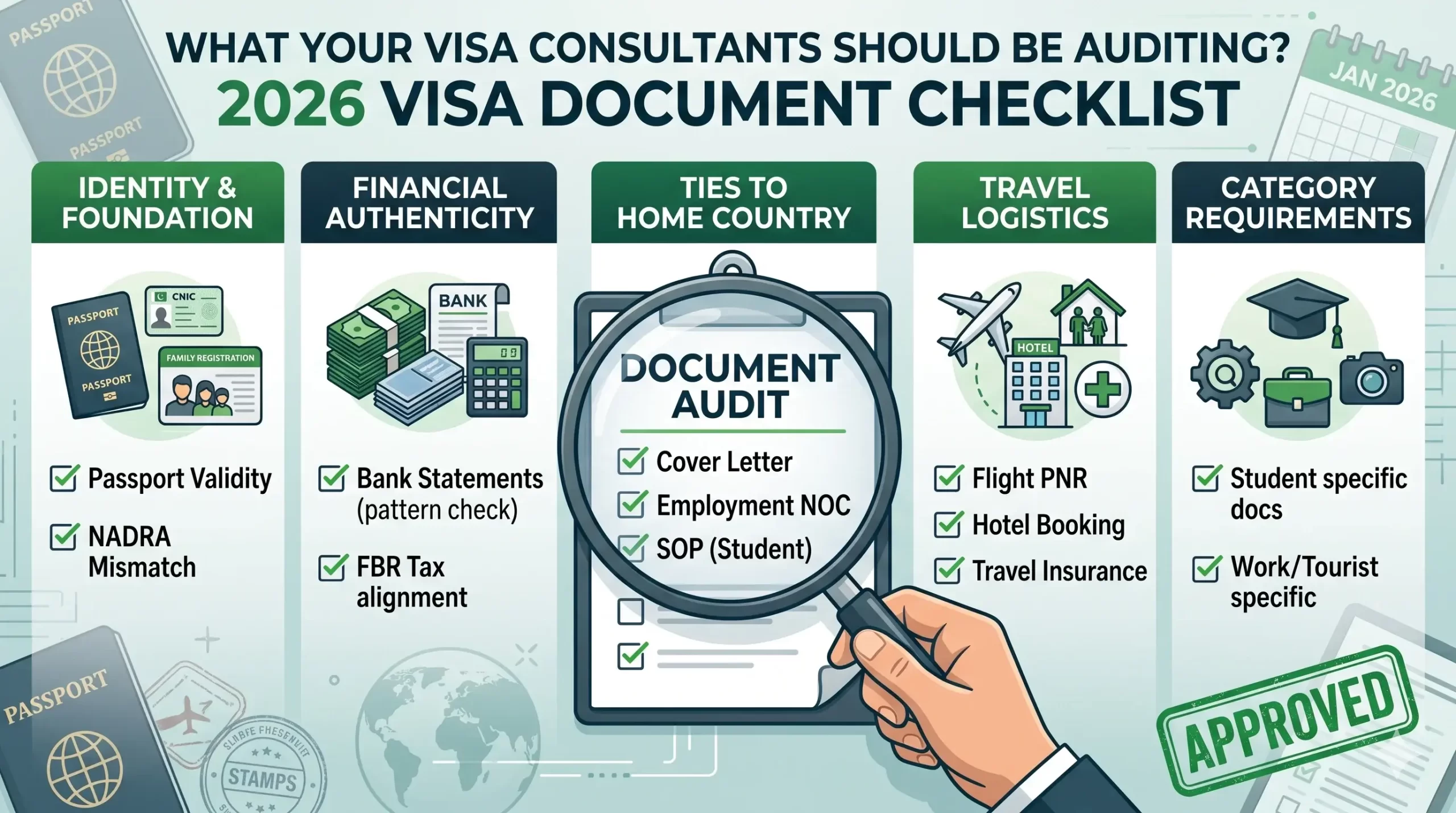
A name mismatch between your passport and NADRA card can get your visa refused. An unexplained bank deposit can do the same. Embassy scrutiny has tightened in 2026. Pakistani applicants face more document checks than at any point before.
Submitting a clean file is not optional. It is the minimum requirement. Professional visa consultants do not just fill out forms. They run a structured document audit across every phase of your file.
This checklist shows exactly what that audit should cover.
| Phase | What Gets Audited | Common Failure Point |
| 1. Identity and Foundation | Passport, CNIC, FRC, NADRA records | Name or date of birth mismatch across documents |
| 2. Financial Authenticity | Bank statements, FBR returns, sponsor letters | Unexplained deposits or income discrepancies |
| 3. Ties to Home Country | Cover letter, Employment NOC, Statement of Purpose | Vague NOC or missing cover letter |
| 4. Travel Logistics | Flight reservation, hotel booking, insurance | Invalid PNR or wrong insurance coverage |
| 5. Category Requirements | Student, work, or tourist-specific documents | Wrong attestation or missing program letters |
Phase 1: Identity and Foundation Audit
Every visa application starts with proving who you are. If your consultant treats this phase as a formality, it is alarming.
Passport validity
Most embassies require at least six months of remaining validity from your travel date. Some countries count from the return date, not the departure date. UAE and Schengen states both follow this rule. Your consultant should check the validity rules for your specific destination.
If your passport was recently renewed, some embassies ask for the old one too. A gap in travel history becomes a question in your file.
NADRA cross-referencing
Your CNIC, Family Registration Certificate, and passport must carry the same name, spelling, and date of birth. A Muhammad on one document and Mohammad on another will make trouble.
Your consultant should cross-reference every foundational document before anything else. If there is a mismatch, the fix starts with NADRA: update the CNIC or NICOP first, then apply for a modified passport. You cannot fix a passport spelling with an affidavit alone. NADRA updates take four to six weeks. Start this process before anything else.
Phase 2: Financial Authenticity
Embassies scrutinize Pakistani financial documents more closely than almost any other part of the file. There is no room for shortcuts here.
Bank statements
A stamped bank statement from the last six months is the baseline. The baseline alone will not protect you. Embassy officers look at the pattern, not just the final balance. Steady income with consistent deposits reads very differently from a dormant account.
If someone transferred money into your account to boost the balance, your consultant must prepare an explanation. An unexplained PKR 2 million deposit is the fastest way to get a refusal.
FBR tax returns and income alignment
Your income tax returns must match your bank statements. Your FBR filing and bank statements must match. If FBR shows PKR 1.2 million annually but your bank shows PKR 3 million, the embassy sees a discrepancy.
Your consultant should reconcile these figures before submission. Finding the gap after a refusal is too late. When they do not match, the consultant must document the source of every deposit over twenty-five percent of monthly declared income. Request a source-of-funds letter.
Check withdrawal patterns to see if the money leaves as quickly as it arrives. Separate personal and business flows using business bank statements, trade licenses, and NTN records. If family members contributed funds, include relationship proof and the sponsor’s own financial trail. Do not submit until every gap has a paper explanation.
Sponsor letters
A sponsor letter alone is not enough. The sponsor’s own bank statements, tax documents, relationship proof, and a written undertaking must all be included. Embassies reject sponsor backed applications when the sponsor’s financial standing is not documented.
Phase 3: Proving You Will Come Back
This is where most Pakistani visa applications succeed or fail. Every document in this phase answers one question: what brings this person home?
Cover letter
A visa cover letter summarizes your trip, your finances, and the documents that support your case. It should be one page. State your purpose directly. End with your name.
Most applicants skip it or write something vague. That is a missed opportunity. A clear cover letter frames your entire file before the officer reads a single bank statement.
Employment NOC
The no objection certificate from your employer confirms your salary, job title, and the leave dates you applied for. A vague line like “we have no objection” without that context is weak. The NOC should make it clear the company expects you back and has a reason to want you there.
For business owners, this means trade licenses, NTN certificates, and recent business bank activity. You are proving the business needs your presence, not just that you own it.
Statement of purpose (student visas)
The statement of purpose must show academic intent, not migration intent. It should explain why this specific program at this specific university connects directly to your career goals in Pakistan. A generic statement that could apply to any university in any country will not convince anyone.
Phase 4: Travel Logistics and Compliance
Trip details must be documented, verifiable, and aligned with the destination embassy’s rules. Weak logistics paperwork suggests a weak applicant.
Flight reservations
Do not buy a full-price ticket before your visa is approved. Embassies want a flight reservation with a valid PNR number they can verify online. Most travel agents offer conditional booking options. They hold your seat without full payment. Your consultant should arrange this so you have a verifiable booking without risk.
Hotel booking or host invitation
Book a hotel with a flexible cancellation policy. If you are staying with a host, you need a formal invitation letter and the host’s ID or proof. Schengen applications sometimes require a notarized declaration from the host as well.
Travel medical insurance
Schengen visas require a minimum coverage of EUR 30,000. The policy must cover all Schengen states and the full duration of your stay. Your consultant should verify the insurer is accepted by the specific embassy. Some consulates reject policies from providers they have not vetted.
Phase 5: Category-Specific Visa Consultants Requirement
Generic checklists treat all visa types the same. Every category has its own document layer. What works for a tourist visa will not work for a student or work visa.
| Document | Student Visa | Work Visa | Tourist Visa |
| Admission letter | CAS, I-20, or CoE required | Not required | Not required |
| Academic records | HEC-attested transcripts and IBCC equivalence | Experience letters from past employers | Not required |
| Language test | IELTS or PTE scores required | Depends on destination | Not required |
| Employer documents | Not required | Job offer and labor market proof | NOC recommended |
| Financial proof | Personal or sponsor funds | Usually employer supported | Personal bank statements |
| Travel history | Helpful but not mandatory | Helpful but not mandatory | Strongly recommended |
Student Visas
Student visa applications require a CAS letter for the UK, an I-20 for the US, or a CoE for Australia. Degree transcripts must be attested by HEC. Intermediate certificates need IBCC equivalence. IELTS or PTE scores must meet the program’s stated requirement, not just the general country minimum.
If your academic gap is over two years, include a written explanation. Embassies flag gaps and question whether the intent is genuinely academic.
Work visas
A job offer letter is just the starting point. Work visa files require labor market testing proof from the employer, verified experience letters from previous positions, and qualification attestation. Your consultant should confirm that the job offer matches the destination country’s specific occupation list for that visa stream.
Tourist and visit visas
A strong tourist visa application includes prior travel history and documented ties to Pakistan. First-time travelers with no stamp history face extra scrutiny. Your consultant should strengthen the file with property documents, business ownership records, or family dependency evidence.
Conclusion
Embassy standards do not become more lenient over time. They become more specific. A document audit before submission finds the problems the embassy would otherwise find for you.
At ATWICS Group, dedicated case managers run a structured audit across every phase in this checklist. Every document is reviewed against the latest embassy guidelines for your specific visa category. Contact ATWICS Group before your file reaches the embassy and get it done right the first time.