
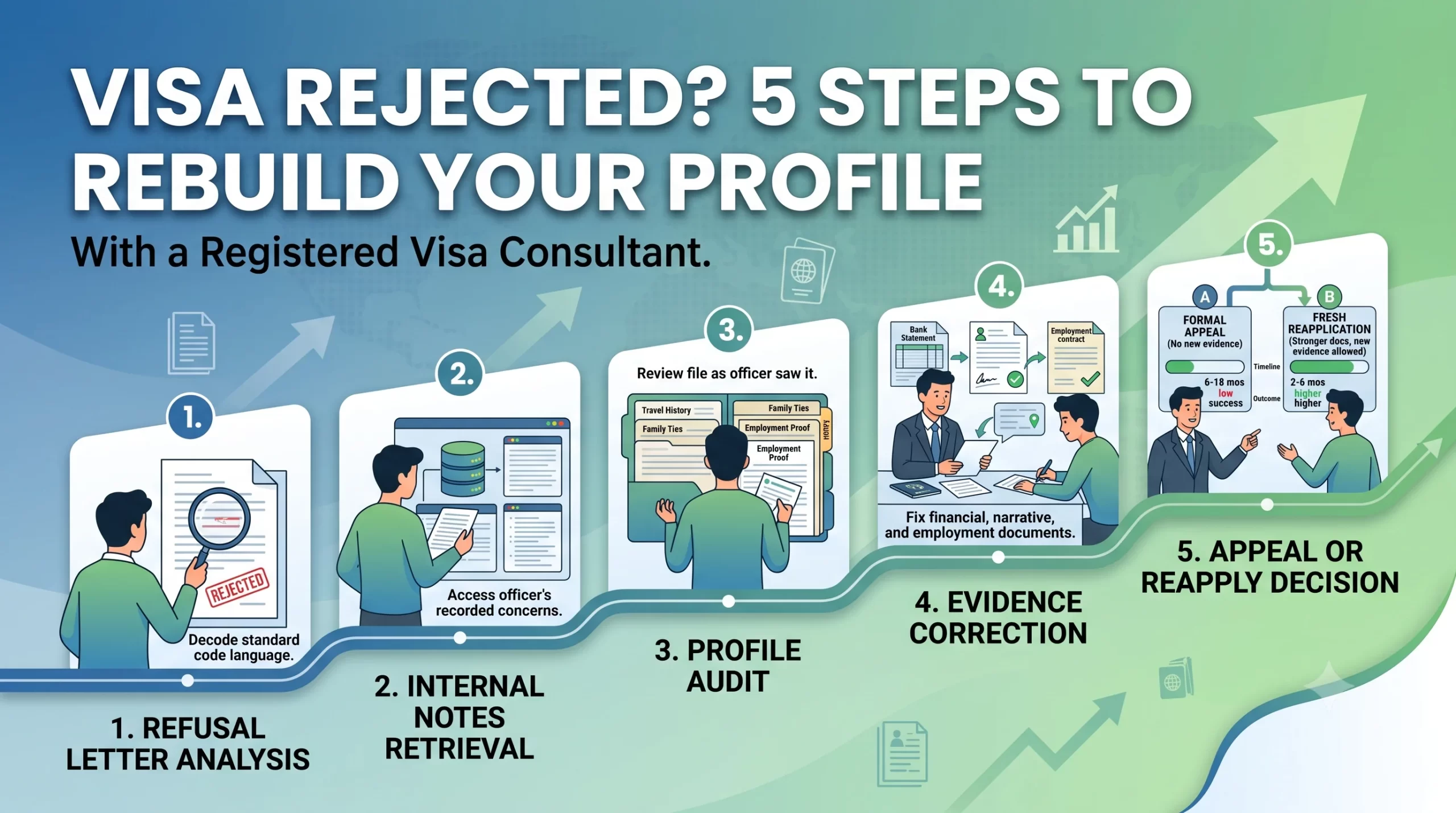
A visa refusal letter tells you about what the visa officer found unconvincing. Most Pakistani applicants treat it as a final verdict. But it is not. It is a documented list of fixable problems.
The most common mistake is reapplying with the same documents. A second submission with the same weaknesses almost always produces a second refusal. Two refusals on your record make the third application far harder to get.
A registered visa consultant does not just file paperwork. The consultant reads the refusal and finds the root cause. Then fix the weakest parts of your profile. The goal is a file the officer cannot reasonably doubt.
The five steps below show exactly how that works.
| Step | What Happens | Why It Matters |
| 1. Refusal Letter Analysis | Decode the embassy’s standard code language | Identifies the actual problem, not the surface complaint |
| 2. Internal Notes Retrieval | Access the officer’s recorded concerns | Shows whether the issue is a document gap or a credibility flag |
| 3. Profile Audit | Review your file as the officer saw it | Finds structural weaknesses you have not identified yourself |
| 4. Evidence Correction | Fix financial, narrative, and employment documents | Removes the specific reason the first application failed |
| 5. Appeal or Reapply Decision | Choose the correct legal route | The wrong choice wastes months and compounds your refusal record |
Step 1: What Does the Refusal Letter Actually Say?
Pakistani embassies rarely write personalized rejection reasons. Most refusal letters use standard code phrases. Each phrase points to a specific documentation gap.
Common refusal phrases and what they mean:
- Insufficient ties to home country: Means weak employment proof, no property records, or missing family dependency documents
- Purpose of visit not established: Means your stated travel reason did not match your financial profile
- Funds not sufficient or credible: Means your bank statements showed sudden deposits or inconsistent income
- Intention to return not satisfied: Means your profile gave the officer no reason to believe you would leave
A registered visa consultant reads these phrases as clinical indicators. Without immigration training, you will misread them. That leads to fixing the wrong problem entirely.
Step 2: The Officer’s Internal Notes Hold the Real Answer
For Canada, the refusal letter is only a summary. The full decision is recorded inside the Global Case Management System. Visa officers use this system to record every concern about your file. Pakistani applicants have the legal right to request these notes.
A GCMS notes application shows:
- Whether the refusal came from a missing document
- Whether it came from a financial inconsistency
- Whether it came from a deeper credibility problem
- Whether a fraudulent agent submitted fabricated documents without your knowledge
That last point changes everything. If a fraudulent agent filed on your behalf, the case is a different problem. It needs a completely different strategy.
For countries other than Canada, a registered visa consultant submits freedom of information requests. These retrieve the officer’s documented reasoning through official channels. Without this step, any reapplication is still questionable.
Step 3: Profile Evaluation Reveals What the Officer Already Saw
A profile evaluation is a structured review of everything the officer examined. That includes:
- Bank statements and savings history
- Employment records and income proof
- Travel history
- Family situation and dependents
- The match between your stated travel purpose and your documented reality
Most Pakistani applicants have at least one structural weakness they have not identified. Take a young professional with no prior international travel. Average bank balances and no property. That profile looks weak to a Canadian or Schengen officer. The officer is not judging your character. The officer is reading risk indicators.
A legal visa consultant maps your profile against the requirements for your visa category. Some gaps take weeks to fix. Others take months. Knowing the timeline stops premature reapplications. Those waste fees and add another refusal to your record.
Step 4: Fixing Weak Evidence Is Where Reapplications Win or Lose
If weak finances caused the refusal, adding money before reapplying does not fix the problem. Officers are trained to spot sudden large deposits with no history behind them. A credible financial profile shows:
- Consistent monthly income
- Regular savings movement over several months
- A balance history that matches your stated profession
Statement of purpose (student visa)
A weak statement of purpose describes what you want to study. A strong one explains:
- Why this specific program at this specific institution is the next step in your career
- Why returning to Pakistan after graduation directly serves your professional future
Employer documentation (work visa)
Labour Market Impact Assessment documents, offer letters, and company registration proofs must form one consistent story. A registered visa consultant works directly with the overseas employer’s HR or legal team. This closes documentation gaps the applicant cannot identify alone.
Step 5: Appeal or Reapply
A formal appeal is only appropriate when the officer made a legal or procedural error. Appeals do not introduce new evidence. They argue the officer misapplied existing rules. For most Pakistani applicants, this is the slower and less successful route.
A corrected reapplication with stronger documents produces faster results in most cases. The registered visa consultant decides which route fits your case. The decision is based on your GCMS notes or equivalent internal records. Choosing to appeal when reapplication is correct adds months to the process. It also adds legal costs without improving your profile.
| Formal Appeal | Fresh Reapplication | |
| When to use | Officer made a legal or procedural error | Your documents were weak or incomplete |
| New evidence allowed | No | Yes |
| Typical timeline | 6 to 18 months | 2 to 6 months |
| Outcome for most Pakistani applicants | Low success rate | Higher when profile is corrected |
| Cost | Higher, legal fees apply | Standard application fees |
ICCRC and MARA: Verify Your Consultant Before Paying
For Canada, only an ICCRC registered consultant is authorized to give immigration advice. They are also the only ones authorized to represent you before Immigration, Refugees and Citizenship Canada. Unregistered consultants offering this service are operating illegally under Canadian law.
For Australia, a MARA registered agent is the legally required representative. MARA registration requires ongoing professional development and compliance with a strict code of conduct. Any agent offering Australian visa services without active MARA registration is operating fraudulently.
Verify credentials before paying any fee:
- ICCRC registration: check the official ICCRC public register
- MARA registration: check the Australian Government’s MARA website
Final Note
A visa refusal followed by a repeat application without changes is not a second attempt. It is the same attempt submitted twice. The officer’s notes record both submissions. The credibility problem compounds.
At ATWICS Group, our registered visa consultants work with Pakistani applicants who have received refusals. We cover Canada, Australia, the UK, Schengen, and the United States. Every case gets a dedicated case manager. The case manager runs all steps from refusal analysis to notes retrieval, profile audit, documentation correction, and reapplication.
Contact ATWICS Group today. Your next submission will be built on evidence, not guesswork.